
Level Two children are highly gifted and the most common in gifted programs.
Level Two children and their parents also experienced difficulties finding a good school fit. Level Two children and adults are highly gifted. One might think that school personnel would notice the advanced abilities of the students and help to adjust the material and pacing for them. As readers will see, that is certainly not the case in the early grade levels.
Let’s look at the longitudinal research results for Level Two children
How to Interpret the Table
The table here summarizes what participants experienced during their regular school years, kindergarten through 12th grade. Each table breaks the school years into a range of grade levels. We can evaluate and report the effectiveness of the school and any modifications for each child by using the School Types.
When the grade range includes some change of situation for the individual student, e.g., a change of schools or entering a different program, then a hyphen is used. The last column for “Fit Quality” uses one of four adjectives — Unsatisfactory, Acceptable, Satisfactory, and Excellent — to describe each grade range and how well it supported the child’s growth in all areas, e.g., intellectual, academic, social, and emotional. My subjective analysis of “fit” is based on a comparison of standardized scores, Level of Giftedness, what each Level needs and whether each setting provided it. The longitudinal study subjects are sorted in the general order of the least to the best good fit within each Level of Gifted in the study.
Types of School Options
• Type I School — A school, usually public, that serves the general population with a wide range of student socioeconomic backgrounds, including recent immigrants still learning English, residents who may be highly mobile (i.e., they change schools often), and sometimes a high proportion of poverty-level students.
• Type II School — This type of school usually draws from a strongly middle-class population with few students from families in either poverty or wealth. It can be public or private.
• Type III School — This type of school is usually either a private college preparatory school or a wealthy district with a reputation for high standardized test scores, a high percentage of students who eventually go to colleges and universities, and a virtually non-existent dropout rate. Students in this setting rarely experience poverty.
• Type IV School — This is a magnet school, public or private, for highly gifted students where admissions are based primarily on standardized test scores and demonstrated achievement.
• Type V School — This is any school, anywhere, which facilitates continuous progress throughout the subject levels without regard for the children’s ages. Examples are schools based on the Montessori method or the old one-room schoolhouses. In an ideal world, we would have only Type V schools.
What I call a Type II school is the kind most of us are familiar with — sort of the stereotypical school environment. A Type III school setting is generally a school in a high socioeconomic public-school system or a private college preparatory school. The main difference between the Type II and Type III schools is usually one of socioeconomics. Settings that have many college bound individual and family expectations make it more likely the student will aim for higher education, as well.
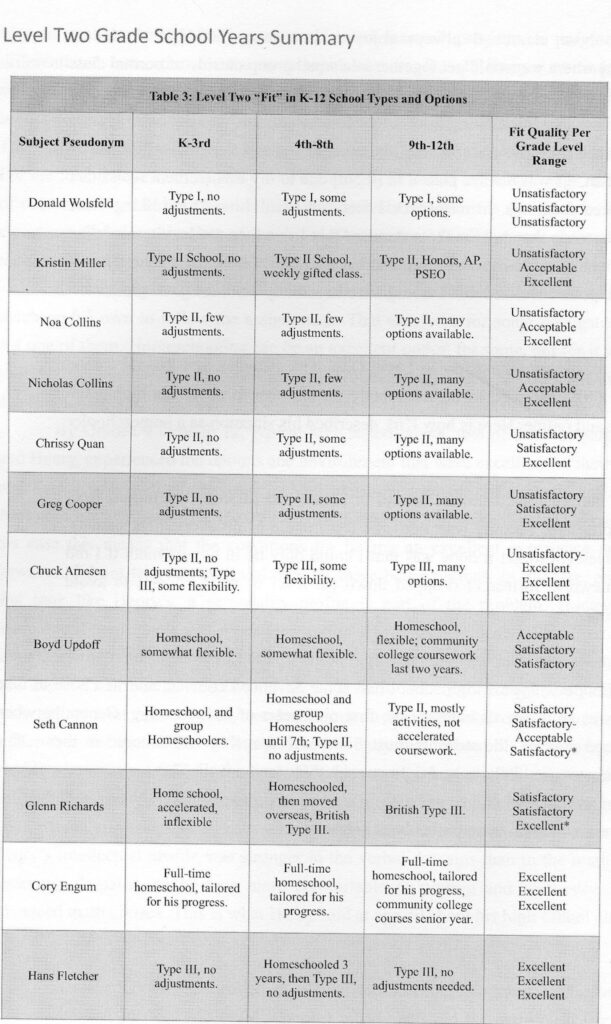

There are 13 people listed in the Level Two table. Level Two learners are generally highly gifted students in the 98th and 99th percentile on standardized tests and who learn more quickly, especially in their strength areas, compared to most students with whom they are typically placed when they start their school years.
Kindergarten through 3rd grade
For seven of these children, their K-3rd grade placement gives an Unsatisfactory result. Despite their high abilities, these seven Level Two students received no obvious adjustments to their school placement or academic expectations during their first four years of school. As the original 5 Levels of Gifted(2005, 2009) book illustrates, their parents tried to work with the schools to get appropriate support but rarely made much progress during these school years.
For Chuck Arnesen, his school days started in a Type II school that provided no adjustments and was Unsatisfactory for him. His family moved to a different city when he finished second grade and placed him in a Type III school that worked very well; the fit there was Excellent for him.
For Boyd Updoff, his Acceptable — rather than Satisfactory — placement rating came even though his family homeschooled him. Homeschooling for these years is typically a good option, but Boyd’s family lived in a rural area, wanted their large family to experience a faith-based curriculum and influence, and the father had a debilitating medical issue during that time. The parents followed a grade-level based curriculum and Boyd did not appear to experience as much acceleration as he could have handled. As he matured, he could contribute more to how his homeschool days would go, and his father’s health situation improved, it became Satisfactory. [The ratings from negative to positive are Unsatisfactory, Acceptable, Satisfactory, Excellent].
The continuing downside, though, was lack of age-mate true peers for Boyd, and it became an issue for him as he went out into the greater world to begin his career.
What Else Should Be Considered When Determining a Good Fit?
By the time we consider what a good fit is for Levels Two and higher, I first consider whether the student has been able to spend time with a smart older tutor or mentor. It is a great social and emotional option when same-aged true peers aren’t available, or even if there are agemate options.
Another issue I consider is whether or not students have the opportunity to experience real challenge and encounter actual new material in their educational setting. For highly to exceptionally gifted students, because there is rarely challenging work or learning to do in most regular classrooms, they can get many misleading ideas about the relativity of how smart and capable they are. And, at some point in their lives, they may be either overwhelmed with things being harder than they’d expected, or they can develop lifelong habits of underachieving or giving minimal efforts, doing only enough to get by.
I often refer to the irony of how some “good” students participate in their own learning to underachieve by going along with what is presented in a system that doesn’t fit them.
Circumstances and results like these listed in the Table make it clear that the need for services and opportunities require that the school or district or state or federal government — at least one or more of these entities! — provide targeted financial support — not just money to do more and more of the same with fancier equipment — to the schools so that no student is left behind due to either lack of appropriate instructional level and pacing or background socioeconomic issues and hardships.
Two book study subjects from the Level Two group experienced Satisfactory learning conditions during their kindergarten through third-grade years. Both Glenn Richards and Seth Cannon were homeschooled in a way that worked for them.
Three children had Excellent academic and social placement.
Cory Engum’s parents homeschooled him. Beyond just textbook lessons, they joined a homeschooling group and took advantage of 4-H and other classes and activities in their vicinity so that Cory got to play and learn with a range of age groups, including other adults, and remain active with lots of real-world, hands-on activities. This set-up was additionally especially good for Cory because he has dyslexia and prefers hands-on learning activities.
Tony Matthews and Hans Fletcher attended a Type III school where there were not only many students as bright as they, but the school also provided some differentiation for their learners, including some subject acceleration.
A Type III school, by its definition, already contains a higher number of college-bound students, so even if there is no differentiation of instruction, a Level Two student in a Type III school is often near the average of the students in the class and surrounded by others with similar post-secondary education and career goals.
The 4th through 8th grade
Only one Level Two student was still in an Unsatisfactory setting during his fourth-through eighth-grade years, middle school. Donald Wolsfeld still attended a Type I school with no adjustments.
For three students who fared better during the next four years of school, two children, Noa and Nicholas Collins, had Acceptable placement because their mother was ceaselessly involved in advocating for her children. Finding the right fit can become a full-time job for many parents.
Kristin Miller’s Type II school added a weekly gifted class, and although not a significant improvement, it did make things better because it made her feel less overlooked and she enjoyed the social aspects of being with other bright students.
Four of the Level Two students were in Satisfactory environments during the middle school stage of their schooling. Chrissy Quan, Greg Cooper, and Glenn Richards experienced some in-school adjustments and conditions that are typical — good but not as much as they need — for highly gifted children in Type II schools.
Boyd Updoff remained home with his homeschooling family throughout his school years. His parents pushed somewhat beyond his grade-level based curriculum, so although Boyd’s instruction continued at a level that was below what he could have handled, he had time and opportunity to learn beyond the curriculum. He was encouraged to do so and followed his interests and curiosity after the regular lessons were finished.
Seth Cannon went from a good homeschool group into a Type II school that made no adjustments and was merely Acceptable for his needs. Homeschooler Cory Engum and Type III school students Tony Matthews, Chuck Arnesen, and Hans Fletcher continued to be in what appeared to be ideal-for-them environments during this period, the so-called middle school years.
The high school years, 9th through 12 grade
Things got better for most Level Two students when they reached high school. Most high schools work fairly well socially for Level Two, and these are the students who are often likely to enjoy taking on leadership roles (Antonakis, J., House, R. J., & Simonton, D. K. (2017).
A possible downside to watch for is that by the time Level Two students are ability grouped for challenging courses, they will meet more students who are smarter than they are — Level Three and Four students in a large high school, or maybe even one Level Five student. Someone needs to explain this to them, and maybe to their parents, so that they don’t assume they aren’t good enough or aren’t trying hard enough when they encounter this new level of competition and “relativity” comparison. As Pam Tice, math teacher and consultant, noted:
I see it all the time with gifted students who encounter profoundly gifted classmates in math class and begin to feel like frauds who don’t belong in these high-level classes just because they have to work harder. Maybe for the first time!
Most Level Two gifted participants had most of their social and emotional needs met in their high school years — 11 of the 13. Nine had an Excellent fit and two had Satisfactory fits.
High schools, for the most part, are the one part of the K-12 school years that continues to group students by ability.
Most high schools, especially in metropolitan areas, offer Advanced Placement (AP) and Honors classes that attract students whose interests and intellect are similar to each other. Also, many states have a post-secondary option available to students who are ready to move on academically.
One could argue Donald Wolsfeld remained in an Unsatisfactory environment for his Level Two needs. Donald was still in a Type I school and there were only modest options available to students like him. Also, his rather small, rural school had a low number of college-bound students and the likelihood of finding true soulmate friends was possible, but not high.
For Boyd Updoff, by the high school years of ninth or tenth grade, he was still homeschooled and finished his K-12 coursework by age 16. In his state, homeschoolers were required to take annual standardized tests to make sure they are learning and on track. His scores were always at the 99th percentile level. Unfortunately, this can be misleading. The tests Boyd was required to take and pass each year were normed against — compared to — other children in his state who were his age and grade-level for the age.
A Level Two learner who is exposed to any reasonable academic schooling is highly likely to score at the 99th percentile on a nationally normed test that compares performance to others at the same age and grade level. But this score does not tell us how he would score compared to the average achievement of students in the state who are four and five years older than he, students who are “average” for their grade level, the ones with whom his achievement should be compared to see if his learning needs are being met as a Level Two student. At this juncture, Boyd took advantage of a program that allowed him the opportunity to avail himself of cost-free post-secondary courses. So, overall, his high school years were a Satisfactory fit.
Tony Matthews, Chuck Arnesen, and Hans Fletcher continued to be in ideal-for-them environments in Type III schools during this period. All three of them came from families with the financial ability to provide the Type III school option afforded people either living in wealthy districts or attending college preparatory private schools.
Again, this is the Level that is most common in gifted programs.
More Information
Post-secondary educational options, PSEO, and other names, is a form of concurrent enrollment where advanced students can college courses free in their state and earn both high school and college credit at the same time.