Hello & Welcome!
Deborah Ruf, PhD
In 2023, Dr. Ruf released her follow-up longitudinal book study of the now-adult children from the original book and how they are doing now. Her focus has now progressed toward the social and emotional health of the gifted adults who parent gifted children. Prior to the book’s release, in 2020, Dr. Ruf published a paper, How Parental Viewpoint and Personality Affect Gifted Child Outcomes in the Gifted Child International Journal. The peer juried paper looks into specific parent-child interactions of the subject families from the 5 Levels book.
For more than 40 years, Dr. Ruf has served as a keynote speaker, workshop, and conference presenter, and written chapters for 5 textbooks, more than 12 peer-reviewed journal articles, and 100 plus articles and handouts for newsletters, magazines, and websites.
Educational Background
- University of Minnesota, Minneapolis, Minnesota, where I resumed my education in January 1986 (with my three children in tow). I graduated in 1998 with a Ph.D. in Psychological Foundations of Education. Major emphases in Learning and Cognition, Measurement and Evaluation. Research specialty in high intelligence.
- University of Virginia, Charlottesville, Virginia, accepted to the PhD program (my married name was Korsmo), and left for Fargo, ND, where my husband’s family lived.
- University of Virginia, Charlottesville, Virginia, graduated 1975 with M.Ed. in Elementary Administration/Supervision. Minor in special education. My married name was Korsmo between July 1973 and 1990 when I legally regained my surname of Ruf.
- Ohio Wesleyan University, Delaware, Ohio, graduated 1971 with B.A. in Elementary Education. Strong liberal arts emphasis.
Previous Licensures
Minnesota Teacher’s License, #353332, grades 1-6, granted November 1996.
Minnesota State Administrator’s License, (all but portfolio), K-12 Principal.
North Dakota State Teacher’s License, granted 1981, grades 1-8.
Virginia State Principal’s License, granted June 1975, Elementary Principal.
Virginia State Teacher’s License, granted 1971, grades 1-8.
Ohio State Teacher’s License, granted 1971, grades K-8.

Business Entities
2000-2017 – Founded and worked as a high intelligence consultant for my own company; named it Educational Options, built a website, hired an executive assistant, and performed intellectual, academic, and social emotional assessments with a gifted clientele. Offered guidance, recommendations, and support, sometimes worked with schools but preferred to teach parents how to find the “best fit” wherever possible based on their child’s profile and needs. Worked with more than 1,200 families and more than 2,000 children over these years.
2009-2016 – Worked with three others to create a business and website entity called Talent Igniter. Its most successful product was an online evaluation for giftedness called The Ruf Estimates of Levels of Gifted©. It is my intellectual property, and one partner did the coding and online placement. Parents filled out the online form about their child’s early milestones, interests, and behaviors, and then got an estimate of their child’s Level and IQ range plus feedback and what to do. We ran the numbers and compared 1,000 results from it to the actual IQ test results for those same children. The correlation was about 85-87% which is as good as the different nationally normed tests correlations are to each other. We ran out of the money to hire marketing specialists and closed down Talent Igniter in 2016.
Certifications & other work experience
- Certified by Riverside Publishing Company as trained and qualified to administer and interpret their highest level "restricted tests" and others, including the Stanford-Binet Intelligence Scales (LM and 5th Edition), the Woodcock-McGrew-Werder Mini-Battery of Achievement, and the Scales of Independent Behavior - Revised (SIB-R).
- Certified in 2003 by Riverside Publishing Company as a trainer for professionals who will administer the Stanford-Binet Fifth Edition Intelligence Test (SBS), for ages 4-85 years. Certified by the Pearson Corporation at their highest level, Level C, to administer and interpret the Wechsler Intelligence Scale for Children - IV (WISC-IV), the Wechsler Preschool and Primary Scale of Intelligence-Ill (WPPSI-III), and the Wechsler Individual Achievement Test-Ill (WIAT-III).
- Trained and certified by Consulting Psychologists Press, Inc., as qualified and experienced in the administration and interpretation of the Myers-Briggs Type Indicator®
- Qualified to administer and interpret the Susan Harter Scales (University of Denver) for the Self-Perception Profile for Children, Self-Perception Profile for Adolescents, Adult Self-Perception Profile, Social Support Scale for Children, Scale of Intrinsic Versus Extrinsic Orientation in the Classroom, Self-Perception Profile for Children with Learning Disabilities, and the Dimensions of Depression Profile for Children and Adolescents.
- 2003-2017 – worked with the companies responsible for normative sampling of the Stanford-Binet 5 (Riverside), and two different Wechsler Intelligence tests (Pearson) and was responsible for securing gifted youngsters and giving them the full formative tests. The normative tests take much longer than a typical testing session because every item plus special subtests must be administered. I also re-tested part of the WPPSI-V group for a digital version of that test. Through this experience, one gains a visceral sense of how these tests work and what they are measuring. I estimate I administered about 160 normative test instruments during this process.
- 340 hours as a Principal Intern in Hopkins Public Schools at the elementary, middle, and high school levels, 1999. Directly involved in evaluating teachers, handling student behavior issues, teaching lessons at the K-6 level, meeting with parents, committees, and the normal meetings and events that are part of the principal's daily life.
- One year as gifted education teacher, K-5, in District 196, MN, 1994-95.
- Administrative and managerial responsibilities as a personal manager in the field of entertainment, 1988-1994. Personal manager for my children in TV and radio advertising and motion pictures. Included securing and coordinating financial, contract, legal, investment, tutorial, public relations, and travel and accommodations both personally and by lining up a professional team to work for my clients. I was the primary person to speak and work with agents, publicists, casting, producers, and directors.
- Conducted 5-year research project on social and emotional aspects of highly and profoundly gifted adults. 1993-1997. Blind study employing written, by-mail surveys. Basic question was this: In a group of highly intelligent people, what role did factors of home and school life play in their adult outcome? Applied theories of Maslow, Dabrowski, and Kohlberg in the analysis. Initial results reported as 41 case studies and their analysis in Ph.D. dissertation, 1998. Excerpts: Environmental, Familial, and Personal Factors That Affect the Self Actualization of Highly Gifted Adults: Case Studies.
- Public elementary school teacher, 1971-1977, outside Washington, DC, in Alexandria, VA, as the area was implementing busing, in grades 4-6. Devised and implemented "readiness" based student grouping across classes and grade levels so that the learning needs of children at different ability and readiness levels could be met without extra funding, resources or space.
- One year privately instructing two profoundly gifted first grade children (one with an IQ in the 200+ range on old SBLM).
- Taught a total of 10 courses of undergraduate and graduate teacher education as an adjunct instructor in both North Dakota and Minnesota. Taught courses in classroom management, school law, gifted education, child development and theories of cognition for Moorhead State, North Dakota State, St. Mary's College, and the University of St. Thomas.
- Fifteen (15) months’ experience in educational administration as Cass County North Dakota Superintendent of Schools (not a school system superintendent but a liaison between school districts and the state’s department of education). Totally revamped central office, worked with the school boards and administrations of 11 school districts, and coordinated local initiatives with state level department of education.
- One year of supervising student teachers in schools along the Red River Valley of North Dakota and Minnesota for Moorhead State University.
Board and volunteer positions
- American Mensa National Gifted Children Program Coordinator, July 2003 to 2008.
- American Mensa National Gifted Children Program Coordinator, July 2003 to 2008.
- NAGC (National Association for Gifted Children) Parent Trust, appointment January 2007. Serve as expert presenter and speaker on behalf of the National Association for Gifted Children's Parents' Division.
- Co-Chair for Parents' Day as part of Local Area Committee planning for NAGC's national convention in Minneapolis, MN, in November 2007.
- Manuscript reviewer for Roeper Review, 2012.
- Specialist on Exceptionally and Profoundly Gifted children for the Davidson Institute for Talent Development, 2005 to 2009.
- Deacon, Westminster Presbyterian Church in downtown Minneapolis, MN, 2006 to 2009.
- Preferred provider recommended by the Institute for Educational Advancement, 2005 to 2016.

Awards
Texas Legacy Book Winner for Losing Our Minds: Gifted Children Left Behind (2005), retitled 5 Levels of Gifted: School Issues and Educational Options (2009).
Mensa Foundation’s Intellectual Benefits award in 2007.
American Mensa service awards between 2002-2006.
Distinguished Alumni Award, Mentor High School, 2018.
MEGT, Minnesota Educators of the Gifted & Talented, Friend of the Gifted 2023.
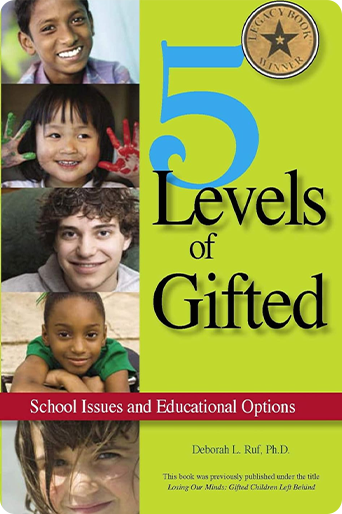
5 Levels of Gifted: School Issues and Educational Options (2009) formerly titled Losing Our Minds: Gifted Children Left Behind (2005).
Purchase Dr. Ruf's Books
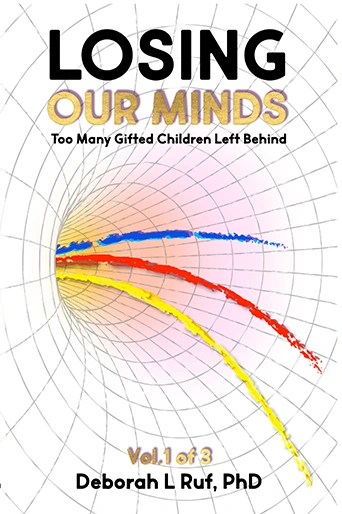
Losing Our Minds: Too Many Gifted Children Left Behind, Vol. 1of 3 (2024)
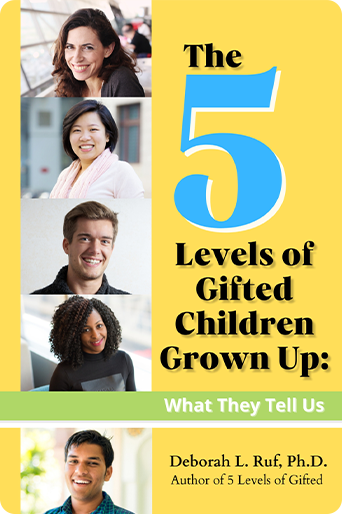
The 5 Levels of Gifted Children Grown Up: What They Tell Us (2023). An 18-year longitudinal study based on the people (subjects) from 5 Levels of Gifted: School Issues and Educational Options (2009), formerly titled Losing Our Minds: Gifted Children Left Behind (2005).

Keys to Successfully Parenting the Gifted Child (2023)

(In press) Working title: How Viewpoints and Personalities Affect Our Lives, Vol. 2 of 3 (late 2026)
Purchase Dr. Ruf's Books
5 Levels of Gifted: School Issues and Educational Options (2009) formerly titled Losing Our Minds: Gifted Children Left Behind (2005).
Keys to Successfully Parenting the Gifted Child (2023)
The 5 Levels of Gifted Children Grown Up: What They Tell Us (2023). An 18-year longitudinal study based on the people (subjects) from 5 Levels of Gifted: School Issues and Educational Options (2009), formerly titled Losing Our Minds: Gifted Children Left Behind (2005).
Losing Our Minds: Too Many Gifted Children Left Behind, Vol. 1of 3 (2024)
(In press) Working title: How Viewpoints and Personalities Affect Our Lives, Vol. 2 of 3 (late 2026)
Chapters in Books
- Chapter: Ruf, D., Schroeder-Davis, S., Hesslein, J., and Keilty, W. (2019). Pathways to Supporting the Gifted: Four Educators' Personal Journeys. In Van Sickle, M., Swanson, J., Bazler, J., & Lubniewski, K., editors, Identifying, Describing, and Developing Teachers Who Are Gifted and Talented, (pp. 149-162). IGI Global.
- Chapter Self-Actualization & Morality of the Gifted: Environmental, Familial, and Personal Factors in Morality, Ethics, and Gifted Minds (2009), edited by Donald Ambrose & Tracy Cross, Springer Publications.
- Entry on Levels of Gifted, Encyclopedia of Giftedness (2009), edited by Barbara Kerr, Sage Publications.
- Assessment Service Bulletin on High Ability Assessment for the Stanford-Binet 5 Intelligence Scales, Fifth Edition, Riverside Publishing (2003).
- Environmental, Familial, and Personal Factors That Affect the Self-Actualization of Highly Gifted Adults: Case Studies," Ph.D. dissertation, completed May 1998.
Peer Reviewed Journals
How parental viewpoint and personality affect gifted child outcomes. Gifted Education International, August 2020.
How Personality and Gender May Relate to Individual Attitudes Toward Caring for and About Others, with David Radosevich, Roeper Review, October 2009.
“If You’re So Smart, Why Do You Need Counseling?” Advanced Development Journal, January 2000, reprinted in Mensa Bulletin, January 2004, pp. 34-39.
Newsletters, Websites, and Handouts
- "The Other Achievement Gap," from How Can We Better Encourage and Reinforce the Most Entrepreneurial and Talented Among Us? in Center for the American Experiment Publication, August 2010.
- "One Profoundly Gifted Kid's Story," September 2008, Parenting for High Potential, the National Association for Gifted Children's parent publication.
- "Do's and Don'ts for Raising Gifted Kids," Mensa Bulletin, August 2004, pp. 24-25.
- "Young and Gifted: Helpful Advice for Parents of Gifted Teenagers," British Mensa Magazine, June 2004, pp. 8-12.
- "Gifted Adolescents: Relationships and Independence," Mensa Bulletin, February 2004.
- "What Gifted Adults Say About Their Childhoods," Mensa Bulletin, November 2003, pp. 20-21.
- "What You Need to Know About Individualizing for the Gifted in Your Schools," Voice: MN Educators for the Gifted and Talented, Fall, 2002.
- "Giftedness and Family Dynamics," MCGT Outlook, Vol. 25, No. 4, 2002.
- "Over-Identification of ADD/ADHD in Gifted, NAGC, Guidance & Counseling Division Newsletter, 2001. Later published on WebMD.
- "Unevenly Gifted," NAGC, Guidance & Counseling Division Newsletter, 2001.
- "Options for a Profoundly Gifted Child;" Highly Gifted Children (Spring, 1996). Most recently updated 2017.
- "Social & Emotional Needs of the Gifted (Adults and Children);" MCGT News (January/February 1995).
- "What You Can Do for Your Gifted Child;" MCGT News (January/February 1991).
- "Prodigy or Not, Your Child Needs an Advocate;" The Single Parent, Journal of Parents Without Partners Vol. 33, No.6 (November/December 1990).
- "Levels of Giftedness;" MCGT News (September/October 1990).
- 'Questions and Answers About Highly Gifted... and More Questions," MCGT News (January/February 1990).
Some Speaking, Interviews,
and Presentation Engagements
- Podcast Interviews, small presentations, etc. through 2025.
- Keynote speaker, ggg999 Conference, October 2016, Orlando, FL.
- MCGT Resource Fair, Minneapolis, MN, 2011.
- Keynote speaker in Sydney and Perth, Australia, invited expert (families and school organizations funded the visit), February 2010. Multiple speaking engagements and presentations in schools and communities, as well as requests for confirmatory SB5 testing, interpretation, and guidance.
- Yellow Medicine, MN, Teacher Training about gifted children and how to meet their needs in the regular classroom. January 2010.
- Iowa Gifted and Talented Association Annual Conference (ITAG) - October 5 and 6, 2009. Iowa City/Coralville, Iowa, Keynotes and Presentations.
- Chaska Area MCGT Chapter Meeting — March 23, 2009, Bluff Creek Elementary,
- Chanhassen, MN, "Social & Emotional Issues of the Gifted."
- Minnesota Mensa Regional Gathering (RG), April 24-26, 2009, Eagan, MN, "How Your Myers-Briggs' Type Affected Your School Performance."
- MCGT 2e Panel — September 27, 2008, Edina Community Center, MN.
- Paper Presentation — Wallace Research Symposium, University of Iowa, May 19, 2008. Topic: "Parent and Gifted Child Personality Types and School Adjustment."
- IECA Keynote Address — May 14, 2008, Independent Educational Consultants Association
- Annual Convention, Minneapolis, MN. Topic: "Underperforming Smart Kids: How to Guide Them to the Right Schools."
- NAGC Conference, Minneapolis, November 7 to 1 1, 2007. Topic: "How Parents Can
- Identify Their Child's Level of Giftedness Prior to Formal Testing."
- The Nueva School's (Palo Alto, CA) Gifted Learning Conference: October 26, 2007. Invited presenter, presentation on Keys to Successfully Parenting the Highly Gifted Child. Palo Alto Unified School District (GATE Program): October 25, 2007, presentation to parents on Parenting the Highly Gifted Child.
- Austin (MN) Public Schools: October 9, 2007, presentation to parents on Personality Types and Intelligence.
- Ohio Association for Gifted Children fall conference: October 7-8, 2007, Parent Day keynote on Levels and Profiles of Giftedness; General Session Keynote “Losing Our Minds:
- Gifted Children Left Behind”; two other small sessions.
- Minnesota Mensa Regional Gathering: September 28-30, 2007. Topics include Gifted Adults: Their Past, Present and Future, and How Personality Type Affects Adjustment for the Gifted.
- Mensa AG, July 4-8, 2007, Birmingham, Alabama, presentations on Levels of Giftedness and Gifted Adults.
- Davidson conference, Minneapolis, MN, summer 2007, presentation on Levels of Giftedness.
- Minnesota School Counselors Association (MSCA) Monday, May 7, 2007, Brainerd. Session Presenter: Levels of Giftedness; Levels and Profiles of Giftedness: What Each Level Needs Answers for Schools.
- Minnesota Parent Institute [National Association for Gifted Children Parent Trust], April 28, 2007. Capitol Hill Gifted Magnet School, 560 Concordia St. Paul, Minnesota. Speaking and presenting: Levels and Profiles of Giftedness; and What Each Level Needs.
- Minnesota Council of Gifted and Talented (MCGT) CHAT Night, April 5, 2007, 7-8:30
- p.m., (CHAT is for Connect, Help, Advocate, Talk.) Lead Chat about the topic of highly gifted.
- Beacon Academy, Golden Valley, Minnesota, February 21, 2007, Teacher Workshop: Levels of Giftedness and What Each Level Needs.
- St. Mary's University, Roseville, February 8, 2007, guest lecturer for certificate course on gifted and talented.
- Littleton Public Schools, Littleton, Colorado, November 27, 2006, presentations and workshops with educators and parents on levels of giftedness.
- December 18, 2005 — Radio interview with Marty Nemko, San Francisco Bay Area NPR, discussed plight of the highly to profoundly gifted in today's schools.
- November 28, 2005 — Lakeville Chapter of the Minnesota Council for Gifted and Talented Lakeville, MN, Keynote: Levels of Giftedness: Meeting Different Needs.
- November 17, 2005 — Radio interview with Kurt Andrews, Bethlehem (Atlanta), GA, WIMO 1300 AM.
- November 9 - 13, 2005 — NAGC Annual Conference, Louisville, KY, Giftedness: How Early Can We Tell?
- November 6, 2005 — Radio show, Viewpoints with Pat Reuters.
- October 22, 2005 — MCGT Annual Conference, St. Paul, MN, Gifted Adolescents: Joys and Challenges.
- October 20, 2005 — Radio interview with Barbara Dooley, Athens, GA, WGAU 1340AM. Topic: How Public Schools Make Gifted Children Average.
- September 29, 2005 — Radio interview for Greg Moore Radio Show, Seattle, Washington.
- September 20, 2005 — Radio interview with Dan Angelo, Riverside, CA, KUCR FM.
- Interview with Michael Shaughnessy of Gifted Education International, July 21, 2005.
- July 6-10, 2005 — American Mensa Annual Gathering, New Orleans, LA. Small Session Presenter: Levels of Giftedness, plus various small group discussions about giftedness in adults.
- July 2004 — SENG Annual Conference, Arlington, VA. "Levels of Giftedness."
- July 2004 — Mensa Annual Gathering, Las Vegas, NV. "Gifted Children Programs."
- May 2004 — Wallace Bi-Annual Conference of the National Research Symposium on Talent Development, The Connie Belin National Center for Gifted Education, University of Iowa Campus, presenter and participant.
- March 2004 — Mensa Leadership Development Workshop presenter, Columbus, OH.
- April 2004 — Mensa Leadership Development Workshop presenter, Hartford, CT.
- April 2004 — Rosemount/Apple Valley, MN, Council for Gifted Children Local Group on "Levels of Giftedness and What Each Level Needs."
- February 2004 — MN Educators for G/T Annual Conference, Brainerd, MN. "Test Scores: What Do They Mean?"
- November 2003 - National Association for Gifted/Talented annual conference in Indianapolis, IN, presenter and participant.
- September 2003 — Minneapolis AAUW, Minneapolis, MN. "Gifted Adults: Who Are They?"
- October 2003 - Presenter at Minnesota Council for Gifted/Talented annual conference in St. Paul, MN. "What to Do When the School Won't Do What You Want It to Do."
- uly 2003 — SENG Annual Conference, St. Louis, MS, "Social & Emotional Needs of the Extremely Gifted."
- January 2003 — Skylight Men's Club, Minneapolis, MN. "Gifted Adults: Who Are They?"
- November 2002 - National Association for Gifted/Talented annual conference in Denver, Colorado; presenter and participant.
- October 2002 - Presenter at Minnesota Council for Gifted/Talented annual conference in St. Paul, MN. Two-part session: "Underachievement: Where Does It Come From?" and "Underachievement: What to Do About It."
- October 2002 — Keynote speech for Council Rock Schools Parents Association, Council Rock, PA. "Levels of Intelligence: What You Can Do for Your Child Now."
- November 1999 - National Association for Gifted/Talented annual conference in Albuquerque, NM, "Highly to Profoundly Gifted: What Are They Like?"
- October 1999 - Presenter at Minnesota Council for Gifted/Talented annual conference in St. Paul, MN. "A Parents' Checklist of Do's and Don'ts for Gifted Kids."
- September 1999 — Presenter at Roundtable Discussion at Annemarie Roeper Conference of Gifted in Chicago, IL. Presented own research results on emotional development of the gifted.
- May 1999 - Presenter at two sessions at Hollingworth Center for Highly Gifted Children, Annual Conference, Boston. Roundtable discussion of moral and emotional development in people throughout their life spans, at home, in schools, and in the work and community environments.
- October 1998 - "Zenith" Parents of G/T group, St. Louis Park Schools, 90-minute presentation to parent group, including question and answer period on topics "Levels and Kinds of Giftedness" and "Working with the Schools."
- May 1998 - Presenter; present doctoral dissertation research results at Biennial Conference of the National Research Symposium on Talent Development, The Connie Belin National Center for Gifted Education in Iowa City, Iowa, at the University of Iowa.
- May 1996 - Hollingworth Center for Highly Gifted Children, Annual Conference at MIT, Boston. 60 - minute presentation on my research findings to date on highly gifted adults, especially social and emotional aspects surrounding family, education, and career.
- April 1996 - Burnsville, MN, Dist. #191 Academic Booster Club, 90-minute presentation to parent group, including question and answer period on topic "Partnering with the School."
- February 1996 - Burnsville, MN, Dist. #191 Academic Booster Club, 90-minute presentation to parent group, including question and answer period on topic "How Do I Know if my Child is Gifted?"
- November 1995 - National Association for Gifted/Talented annual conference in Tampa, FL, "Gifted to Highly Gifted: What's the Difference?"
- October 1995 - MN Council for Gifted & Talented, annual conference, 90-minute presentation entitled "The Usefulness of Ability Testing in a Global Society."
- May 1995- Hollingworth Center for Highly Gifted Children, Annual Conference at MIT, Boston. 60- minute presentation on my research findings to date on highly gifted adults, especially social and emotional aspects surrounding family, education, and career.
- May 1995- Wallace Bi-Annual Conference of the National Research Symposium on Talent Development, the Connie Belin National Center for Gifted Education, University of Iowa Campus.
- March 1995- Reading Assessment Seminar, Minneapolis, MN, featuring Dr. Roger Farr.
- February 1995 - St. Francis, MN, chapter of MCGT, 90-minute presentation to parents and educators on teaching and parenting gifted children.
- December 1994 - Math Enrichments and Challenges workshop with national consultant, District 196, Apple Valley, MN.
- October 1994 - MN Council for Gifted & Talented, featured speaker, annual conference, "Social & Emotional Aspects of Giftedness in Children and Adults."
- June 1994 - Adolescence, Acceleration and National Excellence, Great Barrington, Massachusetts, featuring educators from a dozen acceleration programs throughout the nation including Nancy Robinson, Rena Subotnik, John Feldhusen and Leon Botstein. Small group with lots of interactions between and among participants.