What my newest book is about
First, I apologize for not letting you know enough about this book when I set the publication date of October 26, 2024. I was busy with life and growing older, but with my medical issues, multiple surgeries and medications that sapped the energy out of me over the past 6 years, I started to think about moving from my split level home after my second total hip replacement on October 30, 2024. In January of 2025 I had another surprise surgery, and this time it was to remove a very large cyst that I thought was causing my tummy troubles. No such luck. As happens slowly for many people over their lifetime, that tummy issue was IBS-C. I needed to change the way I was eating! What?
I started looking at retirement settings and wanted a group of fellow residents to be engaged, intellectually active, and—as you already know about me—I wanted a “good fit.” At the same time, I called for a realty group I’d planned to use when the time came, and they said my house was going to sell fast and maybe have a bidding war before there was even an open house (except for the other realtors). Still limping and occasionally using a cane because of my very recent second hip replacement, I was told by the realtor that making the house perfect inside and out required my moving out in April. Plus, I had to move into the retirement community right away to avoid both monthly rent and mortgage. The apartments I picked out in the 13 floor building were not available. I agreed to a unit that was available and totally different from my first “asks.” My house sold in June 2025 when four families immediately bid on it. Whew. All the packing, unpacking, asking for help, donating things, auctioning off other things, worrying, feeling free, etc. wore me out. My grown children live in 3 different time zones from mine. One helped for a week and tossed a lot of stuff out because I couldn’t make up my mind and didn’t have the brawn anyway. He found a large album of Magic the Gathering cards and took it with him.
Fourteen months later I am so grateful for this apartment that was going to be temporary. It is on the ground floor not facing the park and ponds, but it is only 1 apartment off the main entrance. I see and hear everything! It’s perfect for my need for some social interactions while I can easily go right back into my quiet apartment when I’ve had enough socializing. I’m outgoing for only so long. The people are great. I’m back to walking at least 1.5 miles each day and have gone past 3 miles often! There is great walkability, groomed and nature trails everywhere right out my door, and lots of activities and programs that are included. Yay!
So, what’s the book about?
Key Themes and Outcomes
⦁ Giftedness is relative and contextual
Intelligence is experienced differently depending on the surrounding peer group and environment.
⦁ Missing gifted-program cutoffs can have lifelong consequences
Students just below identification thresholds may still require advanced educational support.
⦁ Early educational fit strongly shapes adult outcomes
The quality of K–12 experiences influences later confidence, ambition, resilience, and career choices.
⦁ Challenge and peer connection are essential needs
Gifted learners require intellectual peers and meaningful academic stimulation, not just good grades.
⦁ Most schools are structured around average learners
Age-based grouping and whole-class instruction often underserve advanced students.
⦁ Underchallenge can create poor habits and disengagement
Students who are never required to struggle with their curriculum may fail to develop discipline, persistence, or study skills. Grade level work is simply too easy and leaves no incentive for somehow “trying harder.”
⦁ Success depends on more than raw intelligence
Emotional support, finances, mentorship, family expectations, and opportunity all shape outcomes.
⦁ “Good fit” extends beyond school into adulthood
The search for intellectually and emotionally compatible environments continues into careers and relationships.
What is Giftedness?
Do you ever wonder if you’d recognize it? How do we enable each gifted person to embark on a positive, authentic life trajectory that fosters their individual development?
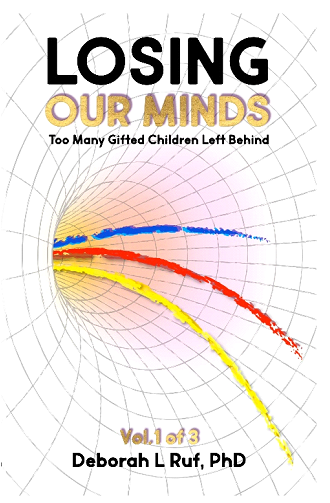
Losing Our Minds: Too Many Gifted Children Left Behind explores how background experiences and opportunities during childhood shape the adult lives of the gifted children in 5 Levels of Gifted: School Issues and Educational Options (2009) as they reach adulthood. Especially for the exceptionally and profoundly gifted children, the importance of a “good fit” in the home, community, and educational environments matter greatly and play a significant role in their futures.
The book offers insight, as well as a practical metric – the Five Levels of Gifted – allowing readers to compare people of equal promise and differing levels of high ability as they progress on their educational paths. The book describes how deeply postsecondary and career choices diverge related to the gifted children’s quality of good fit throughout their childhood years.
Here’s the twist: This newest book is a focused view of the school years of the now adult children from both the 2009 and 2023 books. How did their school years go? How did the parents and schools deal with the varying needs of children in the gifted ranges? After all, they don’t each need the same things during their journey through schools and other options.
Losing Our Minds: Too Many Gifted Children Left Behind (2024) is a detailed follow-up on 5 Levels of Gifted: School Issues and Educational Options (2009). It is the first in a three-part series, based on The 5 Levels of Gifted Children Grown Up: What They Tell Us (2023), which centered on the experiences and insights gained from a 20-year longitudinal study of client families. The author, Deborah Ruf (me), continues to revisit the grown-up gifted children of the initial study, offering unique, first person reports on how their lives and experiences have evolved over the two decades following the initial study.
This book is re-edited and updated, and each chapter now also contains Questions for Discussion, allowing readers to reflect on the insights gained.