
Why the 5 Levels?
The following information is a general summary of the Ruf Estimates of Levels of Giftedness. There is overlap in each of the levels, and inner qualities — qualities that can sometimes change over time due to environmental circumstances — are often the factors that make the difference among several Levels. For example, the degree of personal intensity and drive seem to be one big difference between Level Four and Level Five, the highest level. Some gifted children demonstrate a higher level of intensity and drive than others of similar assessed ability levels, while others only “catch fire” when they find or discover a new interest — an interest they are allowed to pursue — that becomes an all-consuming passion. In the other direction, a gifted child whose inner drive leads him to want to study everything he can get his hands on concerning the ocean, but who is forced to attend school all day with children who cannot yet read well, may at least temporarily lose his passion for learning and appear to be of lower personal drive for the time being.
Here is my most updated table for the Levels and the corresponding IQ score ranges and labels (because people ask for them and not because I totally like depending on scores, because I don’t. My doctoral work focused on Test & Measurement in the Educational Psychology Program at the University of Minnesota and I am aware of how scores are useful but the accuracy for measuring human intelligence with a test is — at best — about 70–75%). This formula is not relevant to the IQ tests children have been taking in school since the Otis-Lennon was first introduced in in 1918 for use with the military and then later with schools.
The nuance of how the scores differ is not even understood by many test makers as they provide ways to get higher scores with different formulas and additions of raw scores. I wrote a big part of the SB5 manual for the gifted subjects and explained it all. Unfortunately, the subsequent narrative by Gale Roid, the main author of that test, fell into the same trap. I pointed this out and Riverside Publishing said the only way I could have it rewritten was if I paid for it myself.
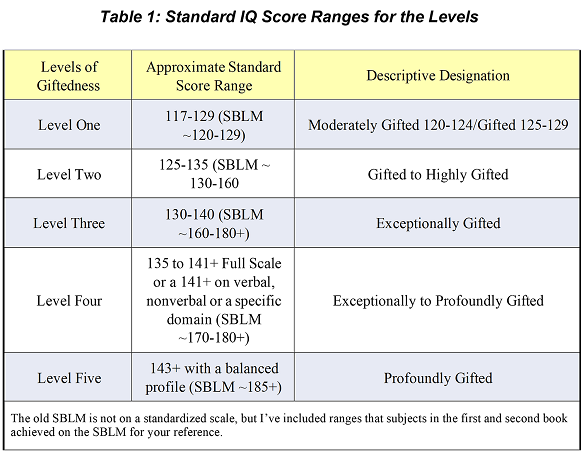
Author Note: The Levels are not designed for clear “cut-offs.” This is not a horse race.
Level One Gifted:
- Approximately 87th-97th percentiles on standardized tests
- Terms Superior* to Moderately Gifted on IQ tests
- IQ scores [1] of about 117 to 129
- Generally top one-third to one-fourth of students in a typical public mixed-ability class
- Many in this Level don’t qualify for gifted programs (scores don’t meet school criteria)
- Predominate gifted program population due to higher frequency compared to Levels Two through Five
- Start kindergarten with end-of-year skills already mastered
Level Two Gifted:
- Mostly 98–99th percentiles on standardized tests
- Terms Moderately to Highly Gifted or Very Advanced on IQ tests
- IQ scores of about 125–135
- As many as one to three in typical mixed-ability classroom
- Qualify for gifted programs
- Second most common in gifted programs
- Master most kindergarten skills one to two years before kindergarten (by age 4)
Level Three Gifted:
- Approximately 98–99th percentiles on standardized tests
- Terms Highly to Exceptionally Gifted or Very Advanced on IQ tests
- IQ scores of about 130 to 140
- One or two per grade level, more in high socioeconomic schools
- Qualify for gifted programs — above level of most other participants and material
- Unless gifted program includes more than one grade level, student may be only one of same ability in gifted class
- Master majority of kindergarten skills by age 3 or 4
- Question Santa or Tooth Fairy (or something similar) by age 3 to 5
- Most spontaneously read with or w/o previous instruction before kindergarten
- Most read simple chapter books by age 5–6
- Most intuitively use numbers for all operations before kindergarten
Gifted Through the Lifespan is a reader-supported publication. To receive new posts and support my work, consider becoming a free or paid subscriber.
Level Four Gifted:
- Primarily 99th percentile on standardized tests, although this understates the person’s ability; it is qualitatively different from a Level Three 99th percentile.
- Also called exceptionally to profoundly gifted
- Full scale IQ scores of about 135 to 141+ or a 145+ on either verbal or nonverbal or a specific domain, e.g. fluid or quantitative reasoning
- One or two across two grade levels; two or three per grade level in high socioeconomic schools (e.g., 100 students in grade level)
- Majority of kindergarten skills by age 3
- Question such concepts as Santa or Tooth Fairy by age 3 to 4
- Majority at 2nd-3rd grade equivalency in academic subjects by early kindergarten
- Majority at upper high school grade equivalencies by 4th-5th grades
- Show concern for existential topics and life’s purpose by early elementary school age
Level Five Gifted:
- Primarily 99.9th percentiles on standardized tests, if such differentiation is reported
- Profoundly gifted range or Highly Advanced on IQ tests
- Full scale and domain scores at 145+ (slightly lower if tested after mid-teenage years)
- High intellectual profile across all ability domains, great inner drive to learn across domains (although not necessarily demonstrated in the regular classroom)
- Nationally at least 1:250,000, a higher proportion in metropolitan areas and high socioeconomic background schools
- Majority have kindergarten skills by about 2½ years or sooner
- Question concept of Santa or Tooth Fairy by age 2 to 3
- Majority spontaneously read, understand fairly complex math, have existential concerns by age 4–5 with or without any instruction
- Majority have high school level grade equivalencies by age 7 or 8 years old, mostly through their own reading and question-asking
Note
[1] Gottfredson, L. S. (1998, Winter). The general intelligence factor. Scientific American Presents, 9(4), 24–29.