
The same as they take care of most students. Very little new happens before High School.
In this post, you will start to see yourself, and even if you don’t know your IQ, you’ll start to be able to guess more accurately!
If a child is clearly advanced, surely the school will recognize the child’s advanced speaking and counting and reading abilities, right? A frequent comeback from teachers and principals has been, “We find they all level out by about 4th grade.” And this very typical reaction from the schools has been going on for decades.

“What do you recommend we do for our children?” asked a father who’d just heard me speak at the local gifted conference. I told him that I would need to know more about his family, the school, and any other options they have before I could recommend what would be best for them. He accused me of trying to make money off him rather than give him an answer.
What Should People Do to Support Gifted School Children?
Find the expert and your problems will be solved. Ha! Not necessarily. Human beings are very complex, so recommendations and explanations are rarely simple or easy. Yes, an expert helps, but ultimately, you are the one who has to learn about what will fit your family, your child, and yourself best.
If you choose to take that journey of what works best for you or your child, you’ll find others traveling the same road, which is nice.
The gifted journey is a little bit like what parents of athletes experience as they work together on fundraisers, shuttle kids to events, get all the gear and coaching they need, and cheer their children on. The children make friends with their team mates. The adults, too, make new friends with the other parents.
High intelligence and the needs of the highly intelligent are not well-understood issues. Over the years, I saw many others in the gifted field respond with words meant to acknowledge the question and satisfy the recipient, e.g., “Children like yours need to be placed in stimulating environments and challenged by the subject matter in their classrooms.” It’s an easy way to make people happy for the moment.
Let’s look at my longitudinal research results for Level One children
To understand how school and educational experiences impact the ways gifted children approach higher-level education and careers, we look at what the participants and their parents report about the years leading up to high school graduation. Here we focus on what the school settings were for the participants at Level One.
The most common school options — School Types — that I described are as follows (the numbering is my own):
• Type I School — A school, usually public, that serves the general population with a wide range of student socioeconomic backgrounds, including recent immigrants still learning English, residents who may be highly mobile (i.e., they change schools often), and sometimes a high proportion of poverty-level students.
• Type II School — This type of school usually draws from a strongly middle-class population with few students from families in either poverty or wealth. It can be public or private.
• Type III School — This type of school is usually either a private college preparatory school or a wealthy district with a reputation for high standardized test scores, a high percentage of students who eventually go to colleges and universities, and a virtually non-existent dropout rate. Students in this setting rarely experience poverty.
• Type IV School — This is a magnet school, public or private, for highly gifted students where admissions are based primarily on standardized test scores and demonstrated achievement.
• Type V School — This is any school, anywhere, which facilitates continuous progress throughout the subject levels without regard for the children’s ages. Examples are schools based on the Montessori method or the old one-room schoolhouses. In an ideal world, we would have only Type V schools.[ii]
What I call a Type II school is the kind most of us are familiar with — sort of the stereotypical school environment. A Type III school setting is generally a school in a high socioeconomic public-school system or a private college preparatory school. The main difference between the Type II and Type III schools is usually one of socioeconomics. Settings that have many college bound individual and family expectations make it more likely the student will aim for higher education, as well.
How Many Gifted Children are Likely to be in Each Type of School?
If gifted children are in public or private schools which draw from a working class, rural, or “unsettled” population that experiences lots of moving or poverty, it is a Type I school, and there are likely to be one to three Level One students in each classroom. Double the frequency estimate for a Type II school setting.
If a district has a high socioeconomic population or if there are schools in a district where most of the parents are highly educated professionals, Level One children are high average learners and constitute at least a third of the students in their schools. In a Type III school, Level One students are rarely included in the gifted programs because their assessed IQ scores are slightly below the school’s gifted acceptance or cut-off score. However, the American professional class is predominantly from a Level One ability range.
For your reference, every Level One study participant was born between 1990 and 1995, which means they are from the Millennial generation. According to Pew, these people — and those parenting them — experienced these critical events:
The Pew Research Center defines millennials as the people born from 1981 to 1996, choosing these dates for “key political, economic and social factors”, including the September 11 terrorist attacks, the 2003 invasion of Iraq, Great Recession, and Internet explosion.
How to Interpret the Table
The table below summarizes what participants experienced during their regular school years, kindergarten through 12th grade. Each table breaks the school years into a range of grade levels. We can evaluate and report the effectiveness of the school and any modifications for each child by using the School Types.
When the grade range includes some change of situation for the individual student, e.g., a change of schools or entering a different program, then a hyphen is used. The last column for “Fit Quality” uses one of four adjectives — Unsatisfactory, Acceptable, Satisfactory, and Excellent — to describe each grade range and how well it supported the child’s growth in all areas, e.g., intellectual, academic, social, and emotional. My subjective analysis of “fit” is based on a comparison of standardized scores, Level of Giftedness, what each Level needs and whether each setting provided it. The subjects are sorted in the general order of the least to the best good fit within each Level of Gifted in the study.
Level One Summary of the Kindergarten Through High School Years
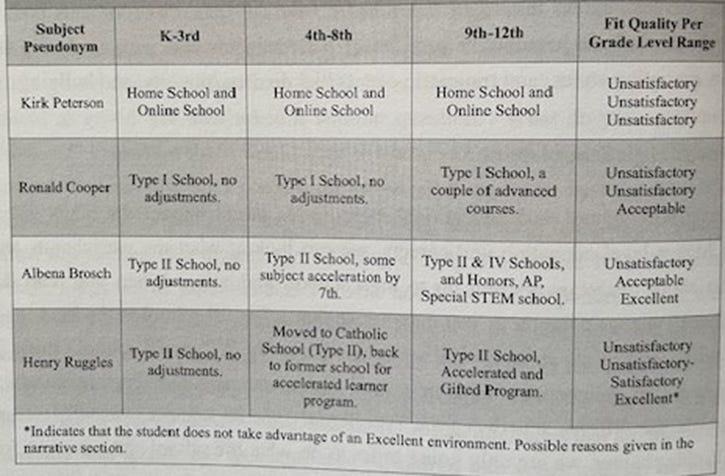
Results for Level One in Kindergarten Through Grade 12
All four of the Level One people in this study had Unsatisfactory learning and social “fit” in their kindergarten through Grade 3 school years (K-3rd in the summary table). Notice that the first four years of typical schooling have likely set many gifted learners on a path of frustration and underachievement. Most gifted identification and programming — if there is any — begins during third grade.
The achievement range within a typical middle school mixed ability seventh-grade class ranges from approximately third-grade equivalency to post-graduate college level (Lohman, D., 1999). Lohman, co-author of both the Cognitive Abilities Test and the Iowa Tests of basic skills, both widely used by public schools for their elementary school students, states,
“The typical public school first-grade classroom already has 12-grade equivalencies of achievement in it.”
Middle schools are different from elementary schools primarily because the students move from class to class for their different subjects instead of being taught by the same teacher all or most of the day. Because of this class and schedule structure, middle school teachers see many more students in one day than elementary teachers. This means it takes longer for the teacher to know the students well enough to respond effectively to their individual or unique learning profiles until further into the school year.
And middle schools, like elementary schools, almost always group students by age rather than ability profile. Since the achievement gap between the slowest and fastest learners gets larger every year, the gap between the classroom instructional level and the gifted child’s achievement and ability level is large by the time a child reaches middle school. It also depends on how gifted the child is compared to classmates.
And just to complicate matters a bit more, at every age and grade level, each school year’s population will differ. This means the teacher may have an entirely different group of students with different personalities and needs the next year, so what worked for one year’s students won’t work for the next year’s. To underscore the above explanation, during a workshop I conducted about differentiated instruction some years ago when I was a sixth-grade teacher:
One year I had a dream class, the best and most cooperative students I ever had. I created learning centers, brought in a bean bag “chair” for students to lounge on, and gave the students lots of freedom to select what they were ready to do throughout the day based on my list of lessons and activities. I was shocked the next year when the bean bag was almost immediately destroyed (slashed with scissors) within the first week, the learning centers stood unused, and freedom to move about and create one’s own schedule was a totally unfamiliar concept to them and an opportunity to misbehave and ignore assignments. I still had some gifted students in the classroom, but I had a larger percentage of students with less experience in, shall we say, cooperative learning behaviors?
How the Level One longitudinal study group experienced during their school years
By fourth through eighth grade, the school environment for one of these youngsters, Albena Brosch, shows an Acceptable rating because she started to receive some subject acceleration, which she enjoyed.
Henry Ruggles started this time period in Unsatisfactory circumstances when he changed schools temporarily, but things improved to Satisfactory when his old school placed him in an “accelerated learner” program, a program that provided differentiated instruction for the more rapid learners.
Ronald Cooper continued in his Type I school with the Unsatisfactory fit where there were no adjustments made for his higher ability.
Since the late 1970s, these school years have continued the practice of whole-class instruction with little to no ability grouping. The curriculum and pacing are designed for the abilities of the average child in the classroom. For the four children in this study who are in Types I and II schools, though, the pace and depth of coursework are below their abilities and interests because it is designed for a lower range of classroom abilities than that of the Level One student. It also means there are too few like-minded classmates with whom to effectively compete, joke around, and befriend.
Kirk Peterson’s home and online schooling was not well-supervised and left him too much on his own to follow the assignments. That can work for some youngsters, but Kirk was not one of them. Homeschooling can be an excellent option for some, but for it to work well, the students’ and the parents’ personalities and abilities must fit each other. This is discussed in more detail elsewhere.
By Grades 9 through 12, typical high school years, two of the four participants, Albena and Henry, experienced the options and environment that were excellent for them. High school is usually the only part of the grade school experience where the students are ability grouped.
Although the Fit Quality for Henry Ruggles during the high school years indicates Excellent, in his case this means that the conditions for having an excellent experience are there. Henry, however, did not take advantage of most of these better options. In his case, and in most cases that look like Henry’s, a personality profile is part of the problem. However, that can be overcome if the schools adjust teaching and goals for such students. When that doesn’t happen, though, by the time students like Henry are in high school, many have lost any belief that things will ever be worthwhile at school. They lack study and time management skills because none were required for most of the years leading up to high school. Henry’s actual ability profile is higher than the typical Level One person, but early input about his early milestones led to my placing him in Level One for the book. What is reported here wouldn’t change if we moved him to Level Two or even Three, because the school’s offerings wouldn’t have changed.
These Level designations are designed to help with planning, and it is not an exact science. Additionally, Henry’s intellectual profile was stronger in the verbal domains than in the math and qualitative reasoning domains, so he was more comfortable in writing and discussion groups than in advanced math classes. This is what Henry said at age 20 about his high school choices:
I stayed involved/enrolled in accelerated learning programs throughout my time at [middle and high] school. I mostly enjoyed the extra push I received through those classes. I always enjoyed the classes like [gifted student program] where we would get together in a small group outside of normal class and learn about interesting things, and think about larger, more complicated topics and issues stimulating intellectual conversation. It was the other classes — like accelerated math courses, for example — that I never liked. But, by association, I was always placed in [them] due to my involvement with other accelerated programs. In retrospect, I feel that I had a hard time liking these classes because they held me to a standard that I was then too lazy to work for. Things had always been easy for me to learn up until I hit middle school math, at which point I realized that I would have to actually work for good grades.
The two remaining youngsters in Level One, Kirk Peterson and Ronald Cooper, fared less well. Kirk continued to be left mostly on his own to cover his high school material at home and online. Here is how Kirk described his situation as a homeschooler:
I was mostly homeschooled. Public school at home, and [a state-run, tuition free] online program. I would wait until the last minute to do everything, parents’ encouragement to get it done was that I could only be in honors math if I did the homework. Instead, I dropped down [in level of math course] to avoid homework.
Ronald Cooper’s Type I high school had some advanced courses, and he chose to take several, so this was an improvement over the first nine years of his schooling. Generally, when there are advanced courses, the students must first prove that they can succeed in them. This means that classmates are likely to be bright enough to do so, as well. These classes were likely the first experiences that Ronald had of being in a group comprised of mostly bright students as classmates, and most of them were probably as bright as he.
Sources and Resources
This post, Kindergarten — 12th Grade Years, is about the Level One longitudinal study subjects from my 2023 book, The Five Levels of Gifted Children Grown Up: What They Tell Us. https://www.amazon.com/Levels-Gifted-Children-Grown-Up/dp/B0C9SHFRLH
In this post, I introduce you to the variety of educational environments the now adult gifted from the 5 Levels of Gifted: School Issues and Educational Options (Ruf, 2005, 2009) book study experienced. A “best fit” for one Level is not necessarily a good fit for children at other Levels, because even within the gifted range, children’s needs differ.
Level One gifted. I coined the 5 Levels of Gifted term in the early 2000s when developing my first book with that name. Level One is the first tier of the rubric and compromises the bright to moderately gifted who, when tested, are in the 90th to 97th percentile range. I gathered early childhood milestones and behaviors from at least 3,000 children’s parents from 1999 into 2023. Specific early milestones correlate as well as actual standardized test results do between different tests when the children and adults are tested later. A 74% correlation is considered the best outcome for such things. They are not perfect because people are so complex. Their entire essence cannot be captured by tests or brain scans. You’ll only find certain strengths and weaknesses. The average IQ of people who become physicians, attorneys, and many others in the professions is about 125.
Pew Research Center. Retrieved 13 March 2019. https://www.pewresearch.org/fact-tank/2019/01/17/where-millennials-end-and-generation-z-begins/
See Oakes, J. (1986). Beyond tracking. Educational Horizons, 65(1), 32–35.
http://www.jstor.org/stable/42926852
See Kulik, J. A., & Kulik, C.-L. C. (1992). Meta-analytic findings on grouping programs. Gifted Child Quarterly, 36(2), 73–77. https://doi.org/10.1177/001698629203600204