
How does early or late talking relate to how smart a child is?
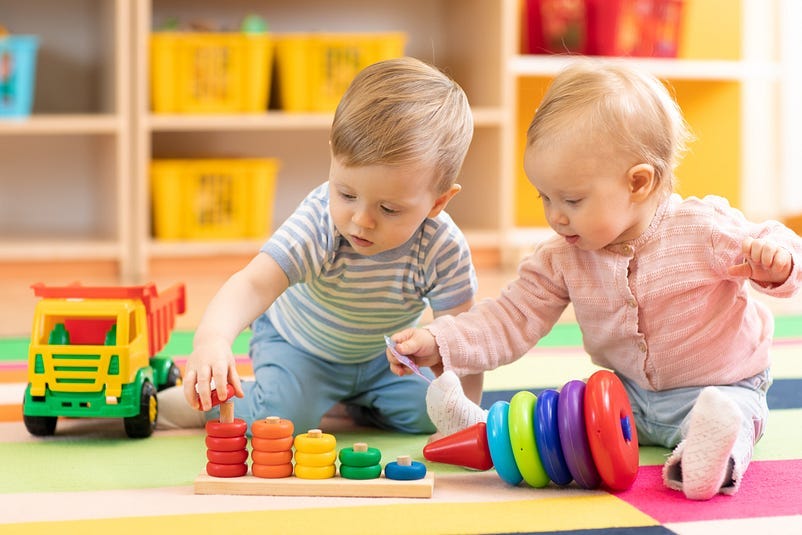
Two families were visiting their great aunt and uncle and chatting with each other as their first-borns, and first cousins to each other, were crawling and toddling around the living room floor in front of them all. Little Sally, about 14 months old at the time, was jabbering away and running circles around her one month younger cousin, Heinz. Sally’s parents were pleased but embarrassed as Aunt Helen oohed and ahhed over how precocious — smart — Sally was. Sally and Heinz have long since grown up, and if either is more intelligent than the other, it’s not as obvious as it was when they were toddlers. What happened? There are several real questions here.
- Are girls and boys naturally different in early talking abilities?
- How does early or late talking relate to how smart a child is?
- Is it proof that a child is very smart when she talks a lot and “sounds smart?”
Whether or not a child talks early is a cause for either delight or concern for most parents — because it is one of the earliest milestones — next to those first steps — that we look for in our little darlings. But what does it really mean? What is early talking? Well, it depends on whether or not you have a little boy or a little girl, an introvert or an extrovert, or a first child or later born, just for starters.
Are girls and boys naturally different in early talking abilities?
Yes, it’s true that girls are more likely to be early talkers than boys because the verbal sections of their brains develop earlier than in the average boy’s brain. In fact, this female verbal advantage continues throughout life. Boys’ development is more visual-spatial with hands-on materials and exploration. Most little boys like to physically try things for themselves. The typical school setting often fits girls better than boys, especially after kindergarten, because school work has lots of focus on reading and writing, and that works better for girls’ interests and abilities than it does for boys’.
How does early or late talking relate to how smart a child is?
According to Hall and Skinner (1980), average children have a three-word speaking vocabulary other than “mama” and “dada” by 14 months, while the average for gifted children is 9.8 months. Research with levels of giftedness (Ruf, 2005/2009) shows early talking — saying several words — starts as early as 5.5 months in some children, and while that’s certainly unusually precocious behavior, some equally intelligent children say very little before they are 20 months old.
Early talking tells us that children are usually advanced in their verbal abilities, but it doesn’t tell us how smart they may be in other areas. Advanced vocabulary often signals a strong memory, high verbal fluid reasoning — putting lots of ideas together, thinking on your feet, and strong knowledge acquisition abilities — children who seem to remember everything — but sometimes an early talker doesn’t have this wide array of aptitudes.
You may have also heard that smart children talk a lot — it’s a common “gifted” trait. While early reading can point to a high probability that a child is smart, some very smart children don’t talk early or talk much. Shy or introverted children, or children with a dominant older brother or sister, may take their time to perfect their abilities before they let anyone hear or see them. Younger children may decide that the older brother or sister can do their talking for them. Some very bright children simply give up trying to compete with their older, talkative siblings. For others, they never turn into “talkers” because it simply isn’t in their nature. This absolutely does not mean they are less intelligent than the talkers!
Is it proof that children are very smart when they talk a lot and “sound smart”?
A good talker can “look smart” and confound parents and teachers when he doesn’t score high on tests of ability or might lack talent in math, for example. Like early reading, early talking needs to be measured in the context of the child’s whole life. What are her other interests and demonstrated abilities?
When a child talks a lot and “sounds smart” it means she will probably always gravitate toward using this ability for her pastimes and her eventual career. When given the chance, most talkers will choose activities, coursework, friendships, and other environments that allow for discussion and interaction with others, especially others who share their interests.
Does an early and continued high ability for using words indicate high intelligence? At the very least, it indicates high verbal intelligence, and when people are allowed to use and develop their strengths, they are very smart indeed.