
Level Three (Highly to Exceptionally Gifted) children and their parents generally had considerable difficulty finding a good school fit.
The school options families have available to them play a role in how good the eventual “fit” is for the Level Three student. Level Three children and adults are Exceptionally gifted. One might think that school personnel would notice the advanced abilities of the students and help to adjust the material and pacing for them. As readers will see, that is often not the case in the early grade levels. This table shows the pseudonyms of the 13 adults in in the study and who were in their late teens to mid-forties when the study ended. This is what their school years were like for them. “No Adjustments” means the child was given the same pacing and curriculum as the other students. No changes or accommodations were made. The most common school options are described as follows:
- Type I School – A school, usually public, that serves the general population with a wide range of student socioeconomic backgrounds, including recent immigrants still learning English, residents who may be highly mobile (i.e., they change schools often), and sometimes a high proportion of poverty-level students.
- Type II School – This type of school usually draws from a strongly middle-class population with few students from families in either poverty or wealth. It can be public or private.
- Type III School – This type of school is usually either a private college preparatory school or a wealthy district with a reputation for high standardized test scores, a high percentage of students who eventually go to colleges and universities, and a virtually non-existent dropout rate. Students rarely have experience with poverty.
- Type IV School – This is a magnet school, public or private, for highly gifted students where admissions are based primarily on standardized test scores and demonstrated achievement.
- Type V School – This is any school, anywhere, which facilitates continuous progress throughout the subject levels without regard for the children’s ages. Examples are schools based on the Montessori method or the old one-room schoolhouses. In an ideal world, we would have only Type V schools.
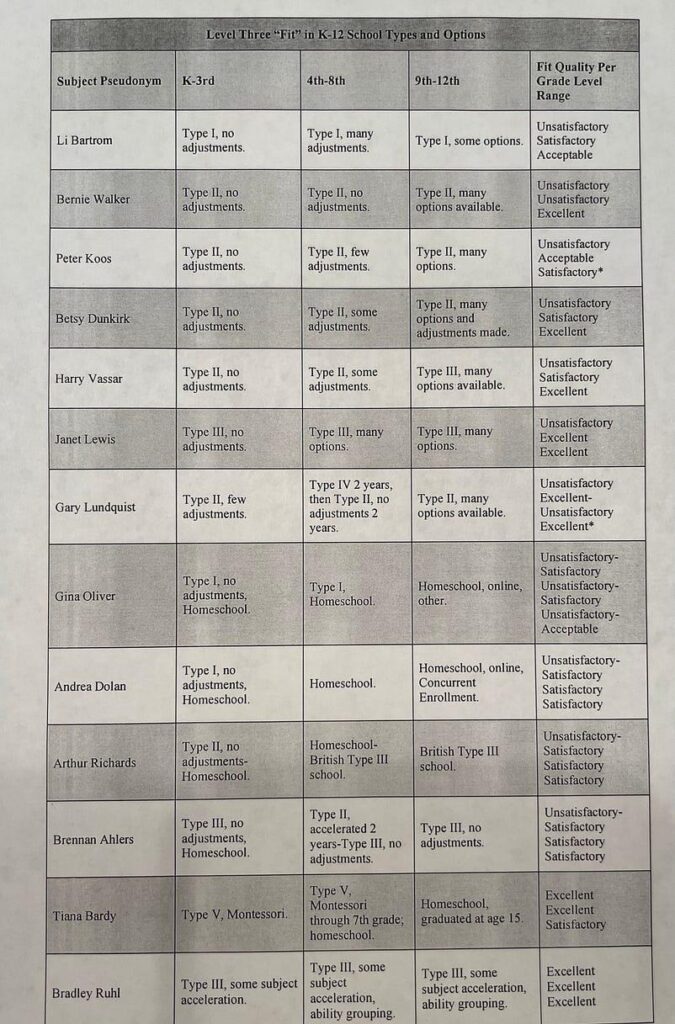
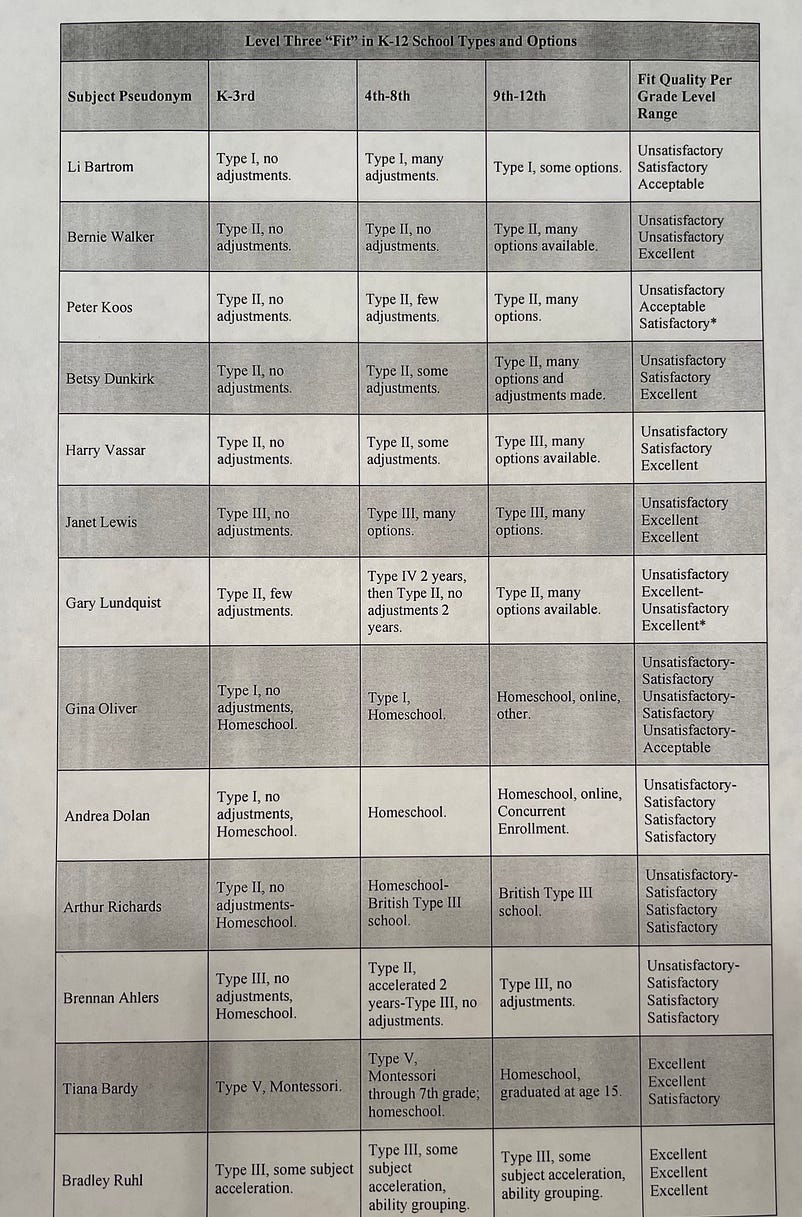
The asterisk * in the above table indicates that the student does not take advantage of an Excellent environment. These kinds of social aspects are covered in the full book.
There are 13 Level Three gifted people from the my original 5 Levels book.
At Level Three, the first four years of school, kindergarten through 3rd grade, are generally problematic. At this ability Level, the School Type is not as certain a solution as it is for Levels One and Two learners. This means that if Level Three children attend a Type I or II school, they absolutely need most of their curriculum and ability grouping tailored to their needs or it will be mostly unsuitable for them socially, emotionally, and academically. A Level Three youngster would usually be the only one who is this intellectually advanced in either type of school.
How Different Are They?
If they could travel through the elementary material at their own pace, most Level Three children could complete all six grades in about two years. Even in a Type III school setting, the student’s highest academic strength areas will need acceleration with classmates who have the same strengths if they are to make good academic progress.
At this point, readers, including parents and teachers, need some specifics on what Level Three children can already do academically and intellectually by the time they start school. Here are the brief early milestones of these gifted youngsters.
Level Three Gifted Early Milestones:
- Approximately 98–99th percentiles on standardized tests
- Terms Highly to Exceptionally Gifted or Very Advanced on IQ tests
- IQ scores of about 130 to 140
- One or two per grade level; more in high socioeconomic Type III schools
- Qualify for gifted programs — but will often still be above the level of most other participants and material. Unless the program includes more than one grade level, student may be the only student of the same high ability in even the gifted class.
- Master majority of kindergarten skills by age 3 or 4
- Most spontaneously read with or w/o previous instruction before kindergarten
- Most read simple chapter books by age 5–6
- Most intuitively use numbers for all operations before kindergarten
Let’s look at the longitudinal research results for Level Three children
Seven children started and stayed in their Unsatisfactory school environments throughout the first four years: Li Bartom, who attended a Type I school, and then Bernie Walker, Peter Koos, Betsy Dunkirk, Harry Vassar, and Gary Lundquist, who attended Type II schools.
Janet Lewis, who attended a Type III school, was not allowed any adjustments to her environment by her school and it was, therefore, Unsatisfactory for her needs during those four years.
All of these children had parents who tried to work with the schools to obtain more advanced curriculum and pacing for their children, but to no avail.
Four children left their local schools during the kindergarten through third grade years and were homeschooled when their parents could not persuade their schools to provide suitable, appropriate learning opportunities for their children. It is often a financial and career hardship for families to make such a choice, too, so few parents make this choice lightly. Andrea and Gina’s parents made this choice to homeschool their daughters when it was clear that their Type I schools were not going to be able to meet their needs. Both had a shift from Unsatisfactory to Satisfactory during this period.
The family of Arthur Richards removed him from his Type II school to homeschool him after none of their requests or advocacy bore fruit. Brennan Ahlers attended a Type III school for his first two years, until educators at the expensive private school told his frustrated parents, “All our children are gifted,” and refused to make any adjustments for him. Brennan’s parents, too, started to homeschool.
Only two Level Three children were off to a good start during the kindergarten through the third grade years. Tiana Bardy attended a Type V Montessori school that worked quite well for him, Excellent. Bradley Ruhl attended a Type III school that added subject acceleration for him.
Keep in mind that the quality of schools was not worse for the Level Three children in this sample; it’s that their needs are different than most schoolchildren’s needs. These were all good schools for most students.

During middle school, their fourth- through eighth-grade years, Bernie Walker was still in an Unsatisfactory learning situation, and Peter Koos had an Acceptable fit in his Type II school where he enjoyed the social aspects of school but remained unchallenged. For those whose fit is Satisfactory or less, a school that might look good on the surface does not necessarily work for each Level Three student or qualify as an Excellent fit.
Li Bartom did not fit her Type I school despite her parents trying to secure good options for her. Brennan Ahlers attended a Type III school that had rigorous academics which did work well, but the social life did not fit him. Betsy Dunkirk craved more challenges in her Type II school. Even when there were more options through these years, she received fewer that were stimulating and challenging than she would have liked, and she says she was left frustrated and unfulfilled.
Gina Oliver started each grade level period needing to re-establish that she needed more than regular grade-level learning opportunities. Her school responded with a few more options for her as she progressed through the grade levels. Gina is a friendly and sociable person, so she made the best of it and appeared to be okay. Unfortunately, when exceptionally gifted students appear to be okay, there is less pressure to supply alternative, more suitable, learning options.
As Gary Lundquist entered 5th grade, his school district implemented a full-time immersion program for highly gifted students that Gary attended in both the fifth and sixth grades. It was perfect for him.
He loved school and said, “It couldn’t have been better!”
Then the district dropped the full-day immersion gifted program for several years and Gary’s academic path, and attitude toward school, shifted radically for the worse. He lost all academic motivation in both middle and high school. Therefore, his fourth- through eighth-grade experience went from Excellent to Unsatisfactory.
Tiana Bardy attended Montessori school until seventh grade when he asked to be homeschooled. Tiana recognized that he needed to explore his gender identity and continuing his education at home was a safe and good alternative to attending regular school. This was a Satisfactory environment for many reasons.
During the traditional high school years, as in the earlier Levels, more Level Three students — six — experienced an Excellent fit. One, Gary Lundquist, was in an ideal academic and friendship environment in his large, suburban Type II school district. The friendship part worked well, but his willingness to fully engage with the academic opportunities was simply gone after the gifted immersion program ended in his middle school years. For these reasons, he has an Excellent Fit Quality designation with an asterisk.Four more people experienced Satisfactory fits, although one of those, Peter Koos, like Gary Lundquist, was simply not interested in taking advantage of all that was available. Li Bartrom and Gina Oliver both still attended a Type I school in a rural area and experienced only an Acceptable fit. They combined online courses with social and extracurricular activities in high school.