
Level Four children and their parents in my first book (5 Levels of Gifted: School Issues and Educational Options, 2009) generally had considerable difficulty finding a good school fit. My second book, my longitudinal study (The 5 Levels of Gifted Children Grown Up: What They Tell Us, 2023), shows us how the outcomes of this high level of giftedness depend on the parenting and the access to good solutions. Here is the link to the detailed description of the book: https://a.co/d/0bCVTcfC. Be sure to read down far enough for the editorial reviews because they can help you to understand what’s going on.
The school options families have available to them play a role in how good the eventual “fit” is for the Level Four student. Level Four children and adults are Exceptionally to Profoundly gifted.
One might think that school personnel would notice the advanced abilities of the students and help to adjust the material and pacing for them. As readers will see, that is often not the case in the early grade levels.
Level Four Gifted Score Range and Early Milestones:
Keep in mind that the Levels are my rubric for helping to describe the ways gifted children differ from each other and what their differing needs requires. IQ scores are but one means of evaluating children’s abilities.
· They score primarily 99th percentile on standardized tests, although this understates the person’s ability; it is qualitatively different from a Level Three 99th percentile, for example.
· A person in the Level Four range is exceptionally to profoundly gifted.
· They have IQ score results of about 135 to 141+ or a 145+ on either verbal or nonverbal or a specific domain, e.g., spatial, or quantitative reasoning. I use the term “about” because a “cut-off” score makes very little sense when one considers the best IQ tests available only correlate with each other about 75%.
· There will usually be only one or two Level Four children across two grade levels; two or three per grade level in high socioeconomic Type III schools (e.g., with 100 students in grade level). School types are listed in the first book and you can discern them by reviewing the tables I’ve provided here.
Achievement behaviors and indications:
· Master a majority of kindergarten skills by age 3
· Question the concept of Santa or Tooth Fairy (or some similar concept) by age 4 to 5
· Majority at 2nd-3rd grade equivalency in academic subjects by early kindergarten
· Majority at upper high school grade equivalencies by 4th-5th grades
· Show concern (or interest) for existential topics and life’s purpose by early elementary school age
Level Four Grade School Years Summary
When I say No Adjustments in the tables, it means the child needed adjustments in that school but didn’t get them.
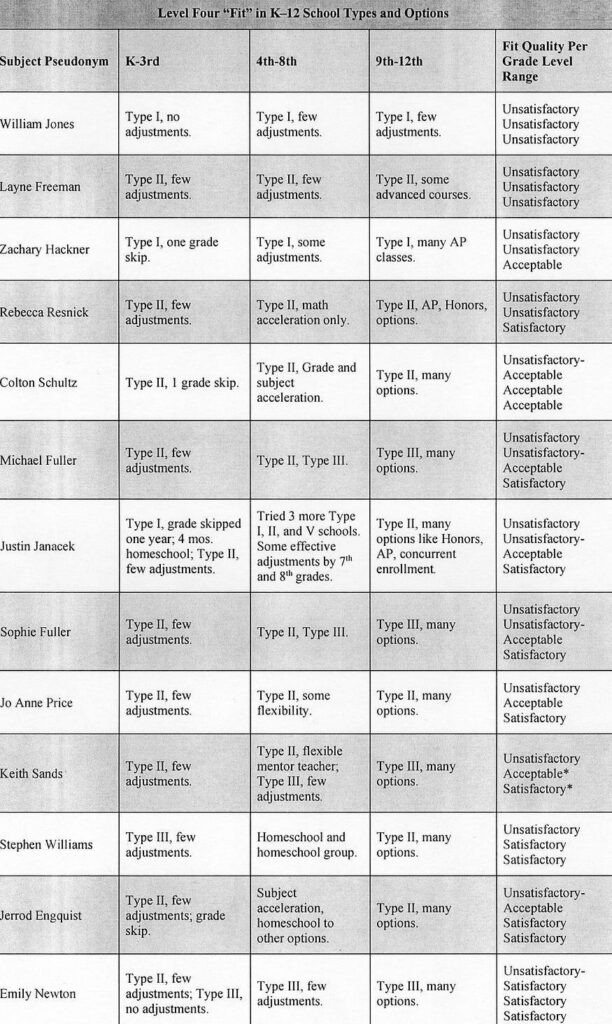
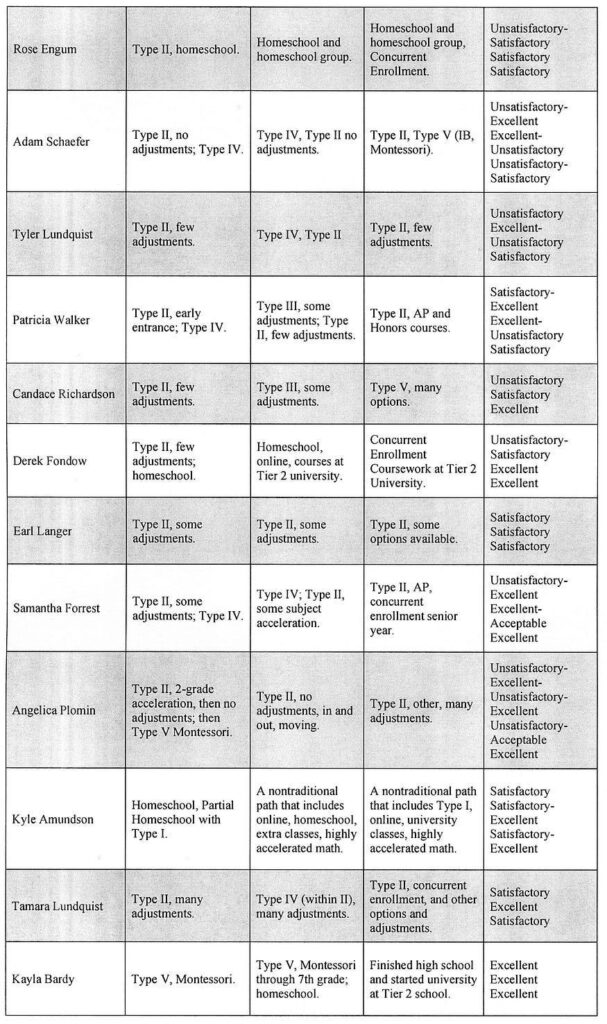
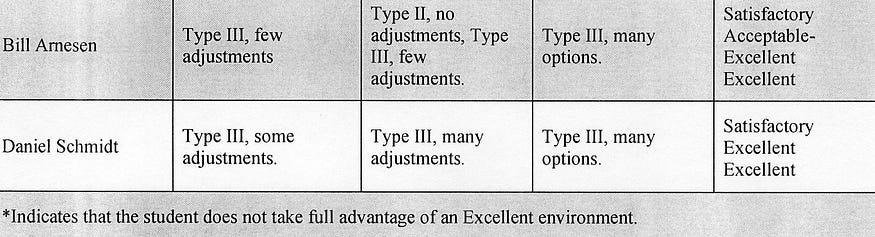
There are 27 Level Four gifted people from the original 5 Levels book.
Level Four includes exceptionally to profoundly gifted children and adults. The original 5 Levels book identified 19 subjects within its sample. Considering the smaller numbers of people who are in the highest intellectual levels — the number of people in the overall population who are extremely gifted gets smaller and smaller as their ability level gets higher and higher — readers might ask where this large group came from.
There are two explanations. One, the present list includes people whose eventual combinations of scores, behaviors, and attainments were not yet available for the first book because the subjects were still quite young when their parents submitted the information. More information for the follow-up study led to moving them from Levels Two and Three to Level Four. But even so, the number 19 seemed high, and 27 might seem extraordinary.
Early on I focused on studying the very highest degrees of intelligence because of my own family “issues.” I needed help! For this reason, more exceptionally and profoundly gifted families than any random sampling would predict sought professional evaluation with me and volunteered for the study because I viscerally “got it” — what they were dealing with — and the parents felt that. In fact, clients and volunteers came from dozens of other states and several countries for evaluation and guidance.
Additionally, my Myers-Briggs personality type is ENTP and although it’s waffled a little bit from time to time, it helps to explain the ways that I’ve done my research and writing. I’ve been driven to find answers about high intelligence and outcomes of the individual who are highly intelligent. ENTP is a rare personality type for a woman.
Let’s look at the longitudinal research results for Level Four gifted children during their K-12 grade school years
The first four years of school, in particular, are highly problematic for Level Four children. As we move up the giftedness continuum, there is a difference in what will work for these exceptionally and profoundly intelligent children compared to the earlier Levels. For example, from earlier descriptions, it is evident that Level One and Two children tend to thrive in Type III schools. Level Three learners appear to do well in most cases when at a Type III school, and yet such a school frequently is not enough for a Level Four gifted child — not academically, socially, or emotionally. Not only will the curriculum’s pace and depth be unsatisfactory for them, but exceptionally gifted Level Four children are too different from most other children of their age and grade level to find a good social fit, either.
There are proportionally fewer ratings of an Excellent fit in the Level Four table at the beginning of this section compared to earlier Levels because what was Excellent for earlier Levels simply is not enough for most of these Level Four youngsters.
Staying at age and grade level leaves Level Four students always waiting for something new to be taught and often does not prepare them to seek and participate in the post-secondary institutions and careers later that would fit them best.
Almost half of the Level Four group — 13 of these exceptionally to profoundly gifted children — stayed in their Unsatisfactory school environments for all four years of kindergarten through third grade. They represent three Type I schools (two of which allowed a one-year grade skip), nine Type II schools, and one Type III school.
Almost all the children in this study were evaluated for their ability and achievement — at their parents’ initiative and expense — during these early school years. Parents are indeed the best identifiers of giftedness and the lack of educator awareness or training about the needs of exceptionally gifted children leads many educators to dismiss the concerns of the parents.
Educators do not normally have coursework in their teacher training classes related to gifted children or the variability of intelligence in general. Most people, including educators, have no idea that social and emotional health are integrally connected to both an intellectual level and profile, e.g., extremely high in one or two ability domains but not as much so in other domains, and the individual student’s social and emotional needs.
Additionally, schools are not set up structurally to allow students to “flow” into the classrooms and environments that will meet their needs based on their ability and readiness to learn new material. For example, if a child is already beyond sixth-grade coursework and curriculum, and the school building itself only has classrooms and grade levels through the sixth grade, what is the school supposed to do? Typically, the reaction to that issue is to slow down any forward progress for advanced students so that they don’t experience too much repetition as they sit through lessons they learned ahead of time on their own. Most gifted adults remember getting in trouble with the teacher if they tried to “read ahead” (Ruf, 1998, https://dabrowskicenter.org/ruf) and that issue is still all too common in schools today.
Some results
During the first four years of school — kindergarten through third grade — only one student experienced an Excellent school environment right away: Kayla Bardy. Kayla attended a Type V Montessori school.
Six other children had a Satisfactory start. Patricia Walker’s parents got an Early Entrance option for her which made her kindergarten and first grade years Satisfactory. A new Type IV public school opened in the area within a year, and Patricia attended Grades 2, 3, and 4 there. It was specifically designed for exceptionally and profoundly gifted children and it was Excellent for Patricia.
Earl Langer’s experience was Satisfactory because he was in a Type II school that had a modest gifted program throughout his grade school years. Both Adam Schaefer and Samantha Forrest started in a Type II school that was Unsatisfactory for them, and they, too, were enrolled in the same Type IV school for their third- through fifth-grade years and found it an Excellent fit.
Both Kyle Amundson and Tamara Lundquist had parents who managed to find ways to make their school situations work for them, Kyle with partial homeschooling and Tamara with numerous in — and after — school options.
Daniel Schmidt and Bill Arnesen attended Type III schools with some moderate adjustments for them. This made the environment Satisfactory, but not Excellent.
Bill attended a Type V Montessori school for two years of preschool and advanced through third-grade material, but when he moved to a Type III school, the school would not consider a kindergarten grade-skip.
The school administered a group ability test to incoming students, including Bill, and when the proctor told Bill to skip anything he did not understand, he took her literally. What he had not understood was the directions, so he skipped an entire section and scored as a Level One Level rather than Level Four. The school concluded at that time that his advanced achievement had been “pushed” by his parents and held him at age and grade level.
Six additional students started with Unsatisfactory school environments but received adjustments that improved the suitability of their environments for them. For example, Angelica Plomin started at a Type II school and it was immediately clear that it did not fit her. The school was willing to give her a two-grade skip within the first several weeks of the school year. It worked until Angelica quickly breezed past her two-years-older classmates. Her parents moved her to a Type V Montessori school where she flourished for the time being. A new job for the father had them move to a different state and start the process again with Angelica’s new school. Her educational experience rating for those years is Unsatisfactory to Excellent for each time she changed schools.
There are no examples of schools responding (i.e., taking any actions to adjust the child’s classroom environment), to recommendations either from past schools or the child’s parents.
Two of the children, Derek Fondow and Rose Engum, were removed by their parents for homeschooling, which was Satisfactory for the time being.
Emily Newton transferred to a Type III school and was expected to “fit in” because, as the school administration told them, “All of our students are gifted,” so it was a better placement for her, but not more than Satisfactory.
Finally, Jerrod Engquist and Colton Schultz, students at Type II schools, were both allowed a one-year grade-skip which made their environments Acceptable for a short time.
As we look at what the Level Four youngsters experienced during fourth through eighth grade, we see that things are still far from ideal for most of them. Four of the students remained in an Unsatisfactory fit: William Jones, Layne Freeman, Zachary Hackner, and Rebecca Resnick. Three more started that time period in an Unsatisfactory fit but were able to move into an Acceptable fit before the finish of their Grade 8 year. Michael and Sophie Fuller, for example, moved from a Type II school to a Type III. It was better, but still not Satisfactory.
Justin Janacek’s parents tried one thing after another as they struggled to find what would meet their son’s needs. He commented during one interview that it made it difficult to form friendships when he so frequently changed schools. Again, Level Four students are extremely unusual and exceptionally rapid, deft learners. There is no child or family in this study who experienced outside sources finding them, funding them, or otherwise coming to their rescue.
Six Level Four youngsters experienced a completely Satisfactory fit throughout the middle school years. That group includes Stephen Williams, Jerrod Engquist, Emily Newton, Rose Engum, Candace Richardson, and Earl Langer.
Four of the subjects, Tamara Lundquist, Kayla Bardy, Derek Fondow, and Daniel Schmidt, all appear to have an Excellent fit during this time. One, Derek, with support from his family for the process, left the traditional path of any regular school and took both online and in-person courses to complete high school via a concurrent enrollment option, which included university course credit, by the end of the Grade 4 through Grade 8 time frame. This means he completed his regular schooling by the time he was 14 years old.
For the children who experienced the previously mentioned Type IV (gifted immersion school) public school for exceptionally to profoundly gifted students for several years, it was an awful change for them to be sent for their middle school years into whole-class instruction with other seventh- and eighth-graders, and their school fit suffered greatly.[vii] For everyone else, there was still upheaval and change as families attempted to work out what would be best for their exceptionally to profoundly gifted child(ren). And, for many families, parents needed to consider what the rest of the family could deal with and manage, too.
The high school years looked better for most Level Four students because, as stated previously, high schools offered most of them access to ability-grouped classes, Advanced Placement courses, and options such as post-secondary school courses that gave them credit for both high school and college at the same time at no additional cost to the family. Nonetheless, Layne Freeman was still one for whom high school offered an Unsatisfactory fit academically and socially. In Layne’s case, this does not mean that she did not have friends. She did. But she lacked enough true peers, intellectual competition, and meaningful discussions. She remained unaware of that loss, however, because she knew nothing else. Her Type II schools are in a large city of a state with a low overall population. She took advantage of the options available to her, but they were restricted due to the small population and limited resources. Examples of such states include Alaska, the Dakotas, Montana, Idaho, and Maine.
Tamara Lundquist had a Satisfactory, not excellent, high school experience for several reasons. When she was still in her twenties, she said this:
I had a bad attitude in my high school years. When I was unable to be in accelerated classes … because of scheduling … I struggled not only to not be bored, but also to not feel some disdain for my classmates. Knowing I was gifted definitely inflated my ego some, but not to a point of not being able to make good friends or learn social skills. I have always been better at making friends with older people than many people my age, but that might be more a result of having older brothers than anything else … I knew that I was smart, but within the context of my family it didn’t feel unusual. I was arrogant in high school, felt way smarter than anyone around me. I had higher test scores and better grades. I eventually discovered I had areas that weren’t as good as others and I became aware of my shortcomings.
Nine of the students experienced a primarily Excellent setting for their needs during the 14- through 18-year-old age range of their lives. Derek Fondow finished his undergraduate degree at a main campus state university near his home during these years, and it was an excellent fit and option for him. Kayla Bardy finished high school and two years of concurrent enrollment university coursework by age 15 while homeschooling.
Fourteen more students found a Satisfactory situation, two were in merely Acceptable circumstances, and two — Layne Freeman and William Jones — were in Unsatisfactory conditions throughout their high school-aged years. Keith Sands’ family moved and changed schools several times during his primary and middle school years, but the setups were merely Acceptable and not Satisfactory. Like Angelica, all the school changing affected his friendship formation and focus. Keith, when in his late twenties, described the frequent changes:
Primary school took place in the US: two years in [a southern state], four years in a [northern state]. Once I started high school, the decision was made by my parents to move back to [mother’s country] and so we applied for a scholarship for a private school near my grandparents’ house. A half-scholarship was granted and so I commenced year 7 at the prestigious grammar school. The first few years went by swimmingly; with two languages and accelerated maths on offer, my attention was largely kept on studies for the time being. The social stuff never worked well. Teachers made me feel that I was disruptive (when asking questions) and there was something undesirable for that. My classmates didn’t make me feel bad, it was just lack of social conversation; I couldn’t relate to the kinds of stuff they talked about. Others were bullied; I was not.
As readers can see, Level Four gifted children and their families faced many issues they had not foreseen and were not sure how to tackle. The results among the 27 participants at this Level varied considerably because different families had different options or views about what to do than some of the other families had. At the same time, there simply were not easy-to-find, affordable resources to support families with their issues because there is rarely a critical mass in any one school or district of students with needs like theirs. Services exist by law for students with any disabilities, but there are very few laws that require schools to meet the needs of the most highly intelligent.
[i] Ruf, D. (2005). Losing Our Minds: Gifted Children Left Behind, (later renamed in 2009 as 5 Levels of Gifted: School Issues and Educational Options).
[ii] Ruf, D. (2023). The 5 Levels of Gifted Children Grown Up: What They Tell Us, 2023, page 61–68.
[iii] See http://www.davidsongifted.org/search-database/entry/a10198
[iv] See Chapter 10, pp. 233–234, in Ruf, D. 2005, 2009.
[v] Ruf, D. (1998). Environmental, Familial, and Personal Factors that Affect the Self-Actualization of Highly Gifted Adults: Case Studies. http://tinyurl.com/sx72hstt
[vi] Early Entrance simply means that the child qualifies, usually through IQ and achievement testing, for entering school before the usual age cut-off requirement in the school or district. For example, if children must turn 5 before September 1st (a common cut-off date) to enter kindergarten, a child with a birthday within 1–3 months of that cut-off can “test in” with scores at 98th to 99th percentile, which is generally a Level Two or higher ability level.
[vii] Ruf, D. (1998). Among subjects in my doctoral dissertation study of highly gifted adults, those who experienced at least one year of gifted immersion classes say that it changed their lives for the better even if it was difficult when the gifted classes ended.
Additional References & Resources
Davidson Gifted.org: https://www.davidsongifted.org/gifted-blog/gifted-education-in-the-u-s-state-policy-legislation/
National Association for Gifted Children: https://nagc.org/page/advocating-at-the-state-level
[1] Ruf, D. (2023). The 5 Levels of Gifted Children Grown Up: What They Tell Us, 2023.
[2] Are Schools Set Up For Gifted Children? (Part I, Level One): https://medium.com/@deborahruf/are-schools-set-up-for-gifted-children-b135afa47a75
[3] Are Schools Set Up For Gifted Children? (Part II, Level Two): https://medium.com/@deborahruf/are-schools-set-up-for-gifted-children-part-ii-level-two-238f8c9a14af[4] Are Schools Set up For Gifted Children? (Part III, Level Three): https://medium.com/@deborahruf/are-schools-set-up-for-gifted-children-part-iii-level-three-ab942d154a2c