Why don’t all gifted children get rich or turn into emotionally healthy, high achieving adults?
That was the question I had that motivated me not only to study giftedness but to answer as many questions as possible about how their early giftedness affected their adult lives. I’d done a retrospective longitudinal study with highly gifted adults for my doctoral thesis. And I’ve completed an 18 year longitudinal study looking for outcomes of gifted youngsters with whom I’d worked.
How did I become a nonfiction writer about giftedness?
My children surprised me with just how advanced of the charts available when they were young. Long before I thought of creating my consultancy or my first book, I began to speak to parent and educator groups and visit scores of families as part of just doing what many parents tend to do with playgrounds, activities, etc., while also trying to see what others were doing with their own bright children. As other parents and I discussed motivation, problems, successes, personal interactions, and other areas of life, the dogging question that came to me would always revolve around discovering what intelligence really is and how it affects a person’s emotions, viewpoints, abilities, and social life. What’s true and what’s not true about the impact of high intelligence on any of these outcomes? I wrote articles, newsletter pieces, and handouts about what I was learning in all these areas.
My experiences with my own young children added to the richness of what I was learning. I finished my doctoral coursework and completed my dissertation: Environmental, Familial, and Personal Factors that Affect the Self-Actualization of Highly Gifted Adults: Case Studies (Ruf, D., 1998). [If you want a free PDF copy, the link is at the end of this post]. The title brought me full circle personally and explained much about my journey in this field and what background I bring to writing books.
Not knowing for sure what I should be doing professionally at that point, I started a consultancy for gifted families. Five years into my consultancy, I decided to publish what I knew so far. I felt what I found during those years could help families navigate both their personal lives and the school systems’ complicated issues. Putting together my data, I wrote my first book and it was published in 2005. It was renamed 5 Levels of Gifted: School Issues and Educational Options in 2009 and is still available on several book selling sites. That book presents information through the concept of the 5 Levels of Gifted — not just test scores — and is a study of 78 gifted children and their lives at home and in school.
Here’s what the first book looked like after it was renamed.
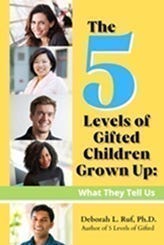
The second book, the longitudinal study, is this one:
How did I decide what was important to know?
As I continued to observe, read, speak, write, and work with at least 700 families over the next dozen years, I realized my earlier understanding of what gifted children need underestimated how complex the issue is. There are additional factors, apart from the schools and the school “fit,” e.g., how well the child fits in at school, that often have as great an impact on gifted children and how they turn out as adults as just “how they do in school.” I wanted to see how the 78 gifted children from the 5 Levels book study turned out. Their parents had provided the information for the first book, and for the second book, The 5 Levels of Gifted Children Grown Up: What They Tell Us (2023). I interviewed more than 50 from the original group and had feedback and social media information from another 15. All of them are now adults. Many have families. The second book is about who they have become and how life has turned out for them so far.
I hadn’t planned to do a longitudinal study or to write about the gifted children from my 2005 book after they grew up.
However, I often received updates from parents of former subjects, and I became curious about how the children were doing now as adults. It wasn’t difficult to find and talk to most of them because I still had contact information for many of their parents. Almost all the parents were willing to approach their grown children about working with me again. Most surprising and enjoyable to discover was how many of the participants in the original study remembered being with me for their ability and achievement testing when they were younger. The follow-up book is about what I learned from the people who agreed to share the current state of their lives and views with me.
Why do so many equally intelligent people turn out so differently?
Much of the follow-up book — and my current writing goals — is about how people who are equally intelligent to each other — according to standardized intelligence tests — have a vast array of learning styles and preferences. These differences generally affect how well they do in school and what subjects and activities they choose to pursue during these years.
In the second book, The 5 Levels of Gifted Children Grown Up: What They Tell Us (2023), I laid out what factors appear most frequently in relation to grade-getting and “doing well in school.” I also lay out what factors appear to relate to poor school performance for some book study subjects. The study shows not only what parents and educational institutions already do, but what they should do also to meet both the learning and social-emotional needs of their gifted students.
What are these books about?
While the first 5 Levels book is primarily about gifted identification and what each Level of Gifted child needs to thrive in school — or alternative educational paths — the second book looks additionally at the social-emotional needs, relationships, career satisfaction, and overall mental and emotional well-being of the now grown study subjects. My purpose is to reveal what personal and background factors influenced and affected the gifted adults’ current self-esteem, self-concept, and overall well-being.
I don’t provide case studies for each person over their lifetimes
Because the subjects are real people, I’ve used pseudonyms for them. I use the same pseudonyms in both books. To honor their autonomy, I didn’t pull anyone’s story into a complete biography or individual case because it might expose people who don’t want to be exposed. The stories are spread out by topic.
The written and oral interviews from this group show there are many personal factors — their personality type and level or profile of intelligence, for example — at play. Furthermore, factors that are part of their environments impact outcome differences among them. Gifted people do not exist in a bubble, and the reactions of others around them as they grow up affect their developmental course in many different ways. Indeed, even though their degrees of giftedness are similar within each Level of Gifted, the study shows a wide range of outcomes among the study subjects and what’s going on in their adult lives so far.
Who is the audience for The 5 Levels of Gifted Children Grown Up?
- It is for concerned parents of gifted children who are struggling in school for unknown reasons or for reasons given by educators that seem unsatisfactory.
- It is for the parents and educators of gifted children who read the first book about the 5 Levels and want to know “what happened to those gifted children; how did they turn out?”
- The information is also for gifted specialists, psychologists, and therapists who work with the families of gifted children.
- It is for education program coordinators and designers.
- It is also for adults who know or suspect they are gifted themselves. My goal is that this latter group can find useful information about the confusing pieces from their own lives and outcomes now that they are adults.
And, perhaps most important to me as I look back over my experiences in this field, this book is for policy-makers from local, state, and national levels. For without good policy and financial support, many gifted children and adults are slipping through the cracks.