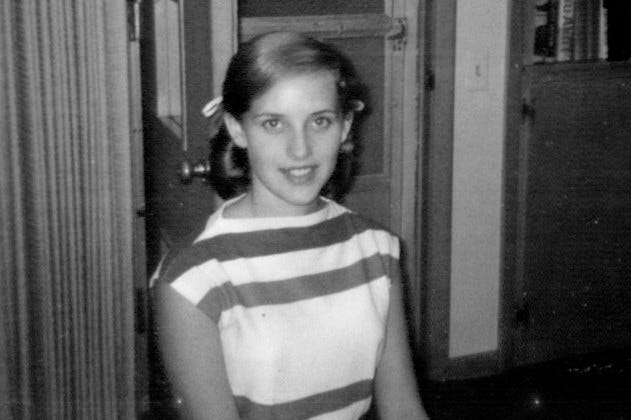
After 6th grade, things got more interesting for this gifted girl!
In a previous post, I talked about my early school years the post called How Author Background Affects What They Write. Here I am the summer before I became an 8th grader.
About the time I was starting 7th grade, I was still acting somewhat serious and sane, and my grandfather commented happily that he was glad to see I wasn’t “boy crazy” like so many girls my age. Oops! Something kicked in within months of that conversation, about the same time I got a crush on the guy, James Darren, in “Tammy Tell Me True” with Sandra Dee.
My mother often told me that school should be partly about doing well in school and partly about learning how to be social and have friends. Having friends hadn’t been all that easy prior to junior high school. I was lonely and not very popular in grade school. And I was bored most of the time, too. But 7th grade was wonderful! And my grades fell. I didn’t even qualify for Junior Honor Society. Oh, horrors.
As the pace and material got more challenging in the later grade levels, I still expected myself to perform as effortlessly as I had in grade school. But as was the case in the old junior high schools for many, many years, and still today with high schools—and this is where relativity again comes in—I was in classes with others who were smart because classes were tracked by ability in the grade levels after elementary school. Many of the students were as gifted as I was. Some were even smarter at some subjects than I was and many were better students. Being around others who were smart and interesting turned me into a social butterfly that year. I was so happy!
Then my social life bottomed out for another school year when most of my classmates went to a new junior high school that opened across town. I was back in classes for 8th grade that didn’t have enough students to draw from to fill each class with only the college-bound smarter kids. I became more studious and competitive during the years I was unhappy. I had far fewer friends that year, too, so I had to find something to do. Might as well get good grades again.
Here I am managing to get out of my classroom by being a Hall Monitor in 11th grade.
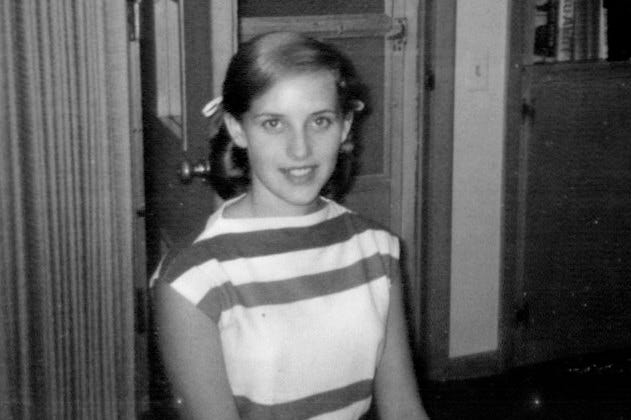
Later, back within a larger ability-grouped setting, I loved school and found it both challenging and interesting in high school. I had friends, participated in lots of school activities, and was in all the high-level classes with others who were college and professionally bound. All of these different settings and ways of grouping students for learning and activities make a difference. It makes it hard for parents to understand their child’s mood swings, too, when their children are not only going through puberty, but they are also often going through classes and settings that can make being in school painful.
What Do We Mean By Ability Grouping and Tracking?
By the late 1970s and through the 1980s, tracking and ability grouping went out of favor. [i] In my longitudinal study of gifted children now grown up, (The 5 Levels of Gifted Children Grown Up: What They Tell Us, 2023), none of the subjects in the first or second of my 5 Levels of Gifted books experienced ability grouping, except through what schools their housing locations or parents provided for them. Some parents, too, opted to—because they were able and had money—send their children to private, elite schools. [ii] My longitudinal study subjects were all in school in the early 1980s or later. In Chapter 2 of the follow-up book (Losing Our Minds: Too Many Gifted Children Left Behind, 2024), I go into detail about School Types that are currently available, although they are not actually available for all students no matter how gifted they are for a variety of reasons, including economic and geographic factors.
I chose the university my parents and other relatives had attended. No one tried to talk me into looking at other colleges. I was so depressed and confused about myself and what I wanted during that period that I was a mediocre student in college. My first-year roommate became my friend throughout college, and although I got along with the people around me, I did not develop any deep or lasting friendships with any other classmates. Whether it had anything to do with intelligence is impossible to know. My depression and insecurity around what was ultimately making me depressed kept me from doing any extra reaching out socially. You’ll see subjects in my book – and my blog posts – reveal similar feelings and behaviors when they left home for higher education. Nothing has changed much as far as meeting the needs of the gifted between the generations.
This is what I used to tell myself and others about my college experience:
“My college did not have as good a mix of people for me; I never felt as though I fit in there.”
Recently, however, I see that it was the first time—except for a couple of overnight camping experiences—that I didn’t know anyone and they didn’t know me. College presented a new social terrain, and I discovered what worked for me throughout my earlier school years did not work well in my college setting.
Or maybe my expectations were wrong; making good friends takes time.
There were many things that confused me about that first year of college. I was perplexed when the college put me in entirely different classes than I’d selected, and while everyone I knew in the first few weeks of the first semester had to take some remedial coursework, I did not have to. Why not? What was going on? Again, I experienced being left out of seeing what could have been helpful information about myself. I was an outlier again and they “took care of it” by having me skip any introductory courses. And it could all be related to my not getting appropriate college choice guidance from my high school counselor before I chose this school. I go to my high school reunions but not my college reunions.
Many gifted adults in the 5 Levels of Gifted Grown Up book talk about the mysteries of what their schools or parents did to help them with their education. And many of the now-adult subjects talk about their shame over not performing—or feeling—better during their school years.
Keep this idea in mind as you read more of my posts or when you move through the chapters of the book where the subjects comment on their social experiences. Aside from my college roommate, there are no people from my graduation year I’ve kept in touch with or would know how to contact. These experiences and feelings of mine from my own younger years have influenced what I write about.
A bad start can have long-lasting effects but people can recover. I’m not here to talk only about what can go wrong for many bright and highly intelligent youngsters and adults; I’m here to let you know that when you do the work of learning more and recovering, you will be intellectually on fire … and happy. It can happen.
[i] Tracking is a form of ability grouping for instructional purposes. See Oakes (1986).
[ii] Not all private schools are elite schools. College preparatory schools tend to be elite in that they have entrance requirements that include ability test scores above average. In most cases, they are also quite expensive. Public schools tend to have broader ranges of intellectual ability in them because they must accept all students, a complete range, from their district.