… and how does it fit into the picture of giftedness?
One of my roles in life has been to be the one who asks the questions others wanted to ask but who were hesitant to ask themselves for fear of looking stupid. So they didn’t ask and sometimes pretended not to have a question even when the teacher or speech-giver asked, “Are there any questions?” People around me picked up on my willingness to take the chance I’d look foolish and would ask me to ask for all of us.
As an example, in a small seminar at the beginning of my doctoral studies in Educational Psychology at the University of Minnesota (1986), the word “zeitgeist” kept being bandied about by the professor and I had no idea what it meant. No one there at the school knew me at all yet. Their reactions to my asking the question did make me feel foolish, at first. The subtle smirks, and the knowing looks, kept me from even remembering if the professor answered my question. I don’t think he did. As more people got to know me and became aware of my propensity to ask embarrassing questions, more and more of them came to me during breaks and fed me the questions they wanted me to ask. My writing, too, is largely like that. Whenever I can, I write about and tell readers things that they didn’t even know they didn’t know. Or were afraid to ask.
Everybody has some combination of styles, views, and personalities. The combination of factors, different expectations, and the learning environment each gifted person has affects how they will turn out. Related to the topic of why we might see and react to the same things differently is a topic that comes up frequently, and that has something to do with neurodiversity.
What Do I Know About Neurodiversity?
More than a year before I published my 2023 book, The 5 Levels of Gifted Children Grown Up: What They Tell Us (2023), https://www.amazon.com/Levels-Gifted-Children-Grown-Up/dp/B0C9SHFRLH, I started to share the draft with others in my field. Additionally, I especially wanted input from therapists and licensed psychologists about how the book was shaping up and if they had anything to add. A few people asked if I cover neurodiversity. At the time, I didn’t know what that was (is) because I was personally focused on how to help people understand giftedness and the range of needs gifted people (children and adults) have for finding a good environmental fit for themselves. But by the time I completed writing the book a year later, I knew I’d better learn what it — neurodiversity — is.
The chapters in Section III of the book begin to show and illustrate the different outcomes of the 65 gifted participants.
[Because The 5 Levels of Gifted Children Grown Up: What They Tell Us (2023) book is enormous, I’m updating and releasing three smaller volumes as part of a series: The 5 Levels of Gifted 20 Year Study Results (1 book series) Paperback Edition. Visit this link to learn more. Section III, Vol. 2 of 3, of the big book is nearly complete and will be released in late 2026].
Parenting style is related to outcomes, and so are other factors including viewpoints and personality type preferences. My viewpoints as this book’s author, for example, influence what I focus on in my writing and recommendations. My personality type preference, currently a Myers-Briggs E/INTP, indicates I am analytical, theoretical, and slightly emotionally detached from idealism (as a T-Thinker rather than an F-Feeler).
Neurodiversity and Twice-Exceptional Children
According to a post by Dona Matthews in Psychology Today, (2021), giftedness is a form of neurodiversity. Most often, however, the term is used as a descriptor for the condition of being twice-exceptional. Not too long ago, we called these learning disabilities, and they are described as impediments to learning in children who should be doing better in school. [See Endnotes for more explanation]. These learning difficulties themselves fall under a large umbrella in that the degree to which they are a problem varies, and parenting styles and views affect how the neurodiversity, the learning differences, etc., are identified and treated. It also sometimes affects teacher views and advice. It has come more and more into play among therapists, too.
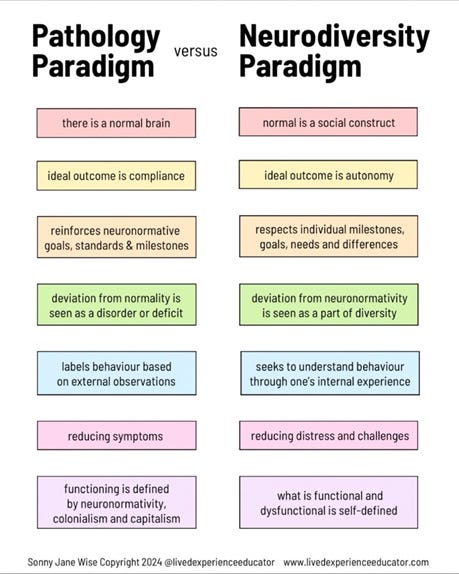
My concern has been that many of the differences between “typical” children and children in the gifted population have often been pathologized and treated as problems with the child, not the environment the gifted child is in. ADHD is a big one. It drives me nuts to hear people say they understand themselves or their child now, what was wrong, and why they couldn’t focus or sit still. They have ADHD! Well, perhaps they do in certain parts of their lives. Perhaps they do because their brain is different, more active, craving the time and space to soak up and think about more things than most other people do. Do we want to tamp down that spark? But is it wrong? Does it somehow explain everything about the person and why they’ve struggled as being because they have a very active brain that needs to slow down or otherwise be “treated” or medicated? My view is that we’ve been treating more symptoms, e.g., not sitting still, not finishing one’s meaningless assignments, etc., than we have been reducing or limiting whatever it is that is negatively affecting the natural spark of the individual. Then I found this table and felt hope!
The left side of the table shows what too many gifted children and adults who have the wrong educational fit experience. The right side allows us to see that “different” or neurodiverse isn’t something to be cured. It is something to be understood, recognized, and treated by finding ways to set up the environments and expectations that the individual gifted learner or worker need to thrive.
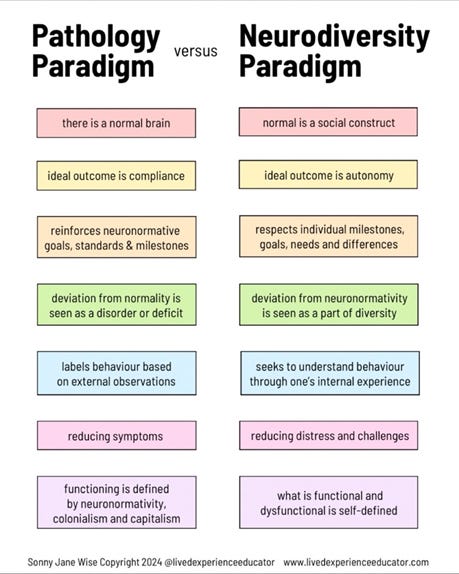
You see, if a parent, teacher, or therapist sees noncompliance in school as an issue of needing to somehow change and manage the child, it can cause lifelong emotional damage and loss of self-esteem or confidence in the gifted person.
In the first edition of the Gifted Children Grown Up book, I don’t specifically cover the issue of “twice-exceptional” because I have always seen so-called disabilities or differences as simply different places on the continuum of how people are. Primarily, we need to provide the “best fit” environment and support children with the goal of becoming “good enough” in their areas of weakness and encourage them to soar in their domains of interest and passion. I’ve always believed the difficulties that keep some people from handling typical school well are also the features that allow them, in the right settings, to really focus on their own unique strengths.
I’ve only recently looked further into the growing field called “neurodiversity,” and it jibes well with what I already thought. This means that my overall recommendations throughout my books and other writing like this post apply to twice-exceptional children, too. And for any child who isn’t thriving in school. Consider that they may be gifted and simply cannot adequately thrive in the environment that has been created for them.
For additional background on the topics of parenting styles and neurodiversity, there are many resources available. It is recommended that anyone planning to rear, teach, or otherwise guide children should be able to learn everything they can ahead of time. And it still won’t be enough — don’t expect yourself to be perfect if you are currently parenting! — because all children are unique and you will still have to be flexible and play it by ear.
What About the Concept of Good Fit?
Have you ever heard someone say, “He has to learn that the world doesn’t revolve around him”? Or “If they don’t prove themselves by getting good grades, they’ll never amount to anything!” Or “She was such a good student and so smart, but what’s she doing now?” As it turns out, all of these viewpoints result in too many gifted children not turning out the ways their parents — and others — thought they should. But it’s not just the parents’ fault. Our schools continue to be set up for the natural cooperators. Some personality types and more girls-than-boys fit that description. In almost every instance of the “problem” child in the school setting, it is not the child but the expectations of those who are not like that child and don’t accurately understand that child. The overall environment in school and at home can exacerbate the issue of the gifted child getting the appropriate education.
Other Resources
A good online resource for parenting is The Attached Family: Parenting for World Harmony. [5] Another, Keys to Successfully Parenting the Gifted Child,”[6] Another, Current Research on Parenting Styles, Dimensions, and Beliefs by Judith Smetana, (2017),[7] can offer new insights and lead to other resources, as well. And a good starting place for the topic of neurodiversity is with these two recent articles: What is Neurodiversity? from the Harvard[8] Medical School, and What Is Neurodiversity: And how can parents support kids who are neurodivergent? from the Child Mind Institute. [9]
For background on the laws surrounding services to children in schools, I’ve provided a link in the endnotes.[10]
Endnotes
[1] The 5 Levels of Gifted Children Grown Up: What They Tell Us (2023).https://www.amazon.com/Levels-Gifted-Children-Grown-Up/dp/B0C9SHFRLH
[2] See Dona Matthews’ explanations about neurodiversity here: https://www.psychologytoday.com/us/blog/going-beyondintelligence/202107/neurodiversity-and-gifted-education#:~: text=Giftedness%20is%20a%20form%20of,are%20children’s%20resulting%20learning%20needs
[3] The term basically means a child is gifted with a learning disability; the child is exceptional in intelligence and has a learning problem. Both conditions need “treatment.”
[4] Different information and ideas on learning disabilities: https://ldaamerica.org/types-of-learning-disabilities/, https://ldaamerica.org/info/adults-with-learning-disabilities-an-overview/
[5] See http://theattachedfamily.com/membersonly/?p=2151 114
[6] Ruf, D. (2023). Keys to Successfully Parenting Gifted Children. https://www.amazon.com/Keys-Successfully-Parenting-Gifted-Child/dp/B0C9GHSJ53
[7] See https://bit.ly/32BBv42 to read the entire Smetana article (scholarly paper). It’s in PDF format.
[8] For more information on neurodiversity see this link to the Harvard Medical School, and What Is Neurodiversity: And how can parents support kids who are neurodivergent? Institute. https://www.health.harvard.edu/blog/what-is-neurodiversity-202111232645
[9] An additional piece that explains the relatively new field of neurodiversity is found here: https://childmind.org/article/what-is-neurodiversity/
[10] ASHA, American Speech-Language-Hearing Association explains much about the 1970s law IDEA, Individuals with Learning Disabilities Act, and how specific conditions or deficits are given mandated educational coverage is found here: https://www.asha.org/advocacy/idea/04-law-specific-ld/ At the time of the legislation, gifted proponents didn’t want to be included because being gifted isn’t a deficit or learning disability. Parents and others soon learned that if learning up to one’s inherent potential isn’t happening for their child, they might not be able to get flexible and adequate gifted education services, but they could get allowances or support for other learning deficits or issues.